WR 135
Observer: LHAA
Spectrum Data
FITS Header Metadata
Show FITS Header
| Key | Value |
|---|---|
| SIMPLE | True |
| BITPIX | -32 |
| NAXIS | 1 |
| NAXIS1 | 2762 |
| CRPIX1 | 1 |
| CDELT1 | 1.45073373056071 |
| CRVAL1 | 3796.24389648438 |
| CTYPE1 | Wavelength |
| CUNIT1 | Angstrom |
| SWCREATE | RSpec 2.1.1.18 |
| VERSION | RSpec 2.1.1.18 |
| OBSERVER | HLAD |
| BSS_SITE | Sandvreten Observatory L11 |
| BSS_INST | T41 |
| OBJNAME | WR 135 |
| DATE-OBS | 2025-12-20T18:37:22 |
| EXPTIME | 900 |
| BSS_VHEL | 0 |
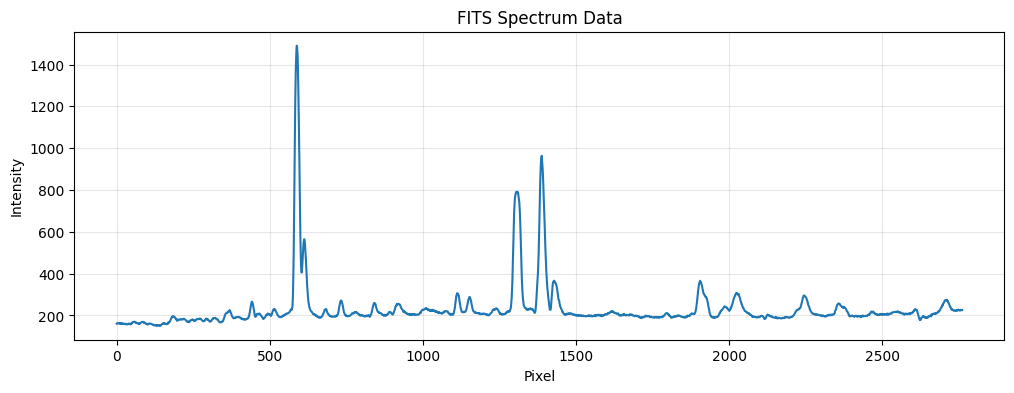
FITS Spectral Image
Click image to open in new tab for zooming
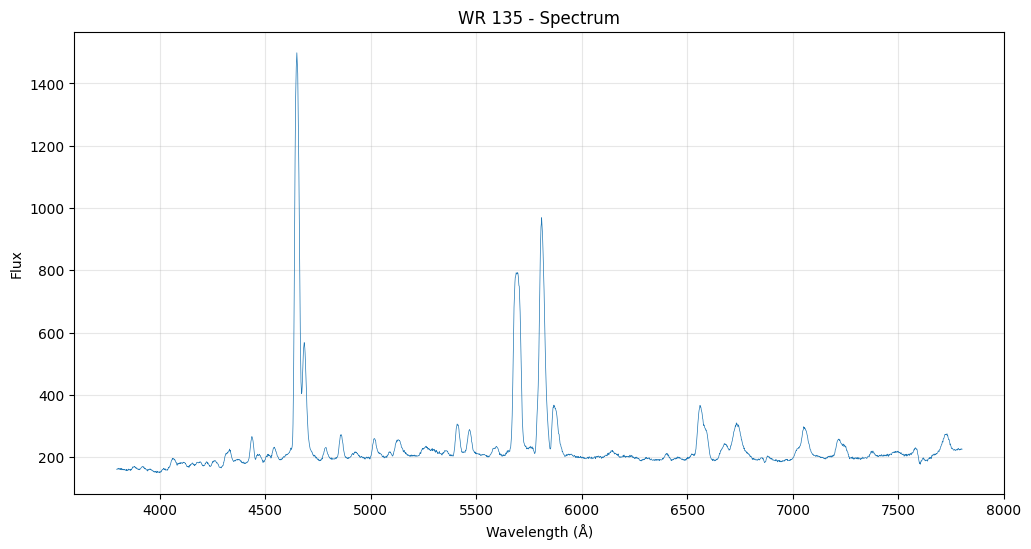
Calibrated Spectrum
Click image to open in new tab for zooming
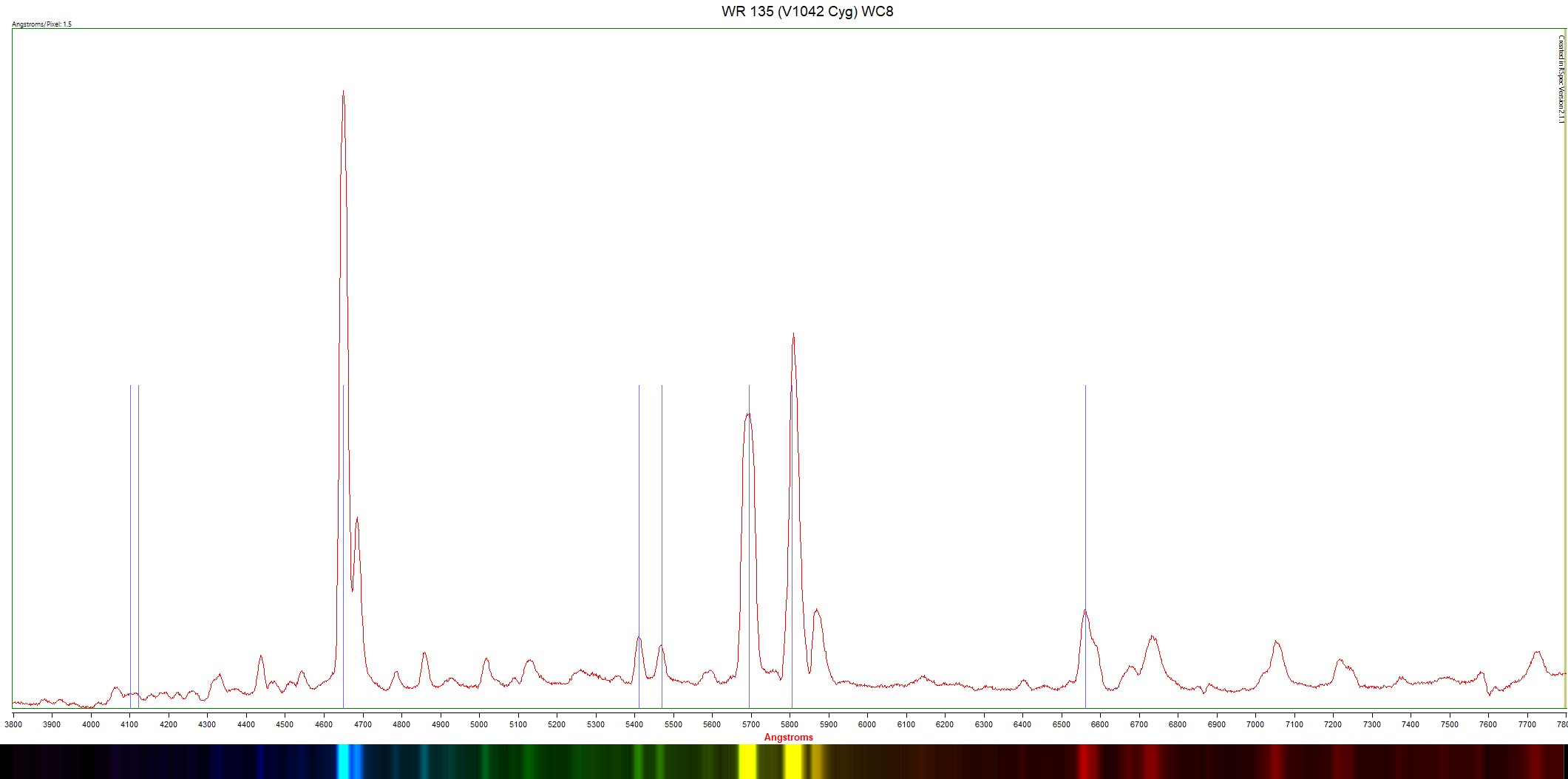
Observation Image
Click image to open in new tab for zooming
Metadata
| Field | Value |
|---|---|
| Object Name | WR 135 |
| Observer | LHAA |
| Site | Legacy Site (update me) |
| Equipment | Legacy Equipment (update me) |
| Observation Date | 2026-01-18 11:19 |
| Julian Date | 2461058.97172 |
| Created | 2026-01-18 11:19 |
| Updated | 2026-01-18 11:19 |
Notes
From Wikipedia: WR 135 is a variable Wolf-Rayet star located around 6,000 light years away from Earth in the constellation of Cygnus, surrounded by a faint bubble nebula blown by the intense radiation and fast wind from the star. It is just over four times the radius of the sun, but due to a temperature of 63,000 K it is 250,000 times as luminous as the sun. WR 135, together with WR 134 and WR 137, was one of three stars in Cygnus observed in 1867 to have unusual spectra consisting of intense emission lines rather than the more normal continuum and absorption lines. These were the first members of the class of stars that came to be called Wolf-Rayet stars (WR stars) after Charles Wolf and Georges Rayet who discovered their unusual appearance. It is a member of the carbon sequence of WR stars, indicated by the lack of nitrogen lines and the strength of carbon emission. WR 135 has a spectrum with CIII emission slightly stronger than CIV, leading to the assignment of a WC8 spectral type. The spectrum also shows strong HeI emission and weaker lines of HeII and CII.