Bellatrix
Observer: GDAA
Spectrum Data
FITS Header Metadata
Show FITS Header
| Key | Value |
|---|---|
| SIMPLE | True |
| BITPIX | -32 |
| NAXIS | 1 |
| NAXIS1 | 2971 |
| CRPIX1 | 1 |
| CDELT1 | 1.44750392926662 |
| CRVAL1 | 3691.50170898438 |
| CTYPE1 | Wavelength |
| CUNIT1 | Angstrom |
| SWCREATE | RSpec 2.1.1.18 |
| VERSION | RSpec 2.1.1.18 |
| OBSERVER | Grzegorz Duszanowicz |
| BSS_SITE | Sandvreten Observatory L11 |
| BSS_INST | T41 |
| OBJNAME | Gamma Ori |
| DATE-OBS | 2026-01-29T20:13:07 |
| EXPTIME | 60 |
| BSS_VHEL | 0 |
FITS Spectral Image
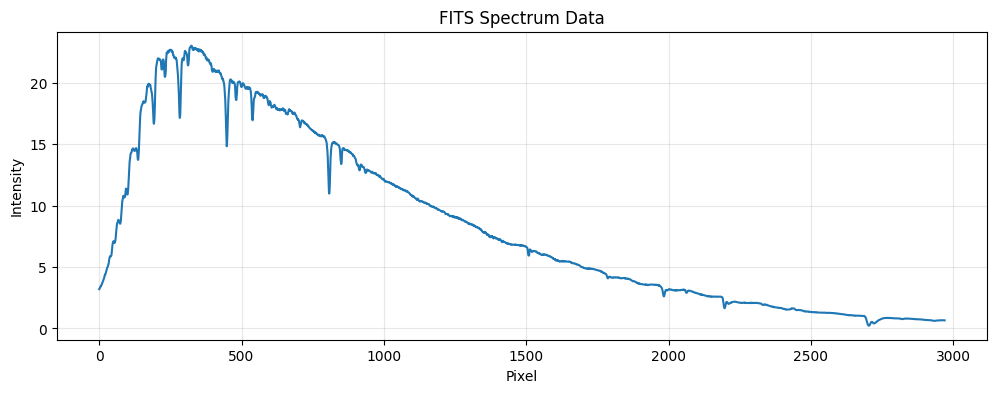
Click image to open in new tab for zooming
Calibrated Spectrum
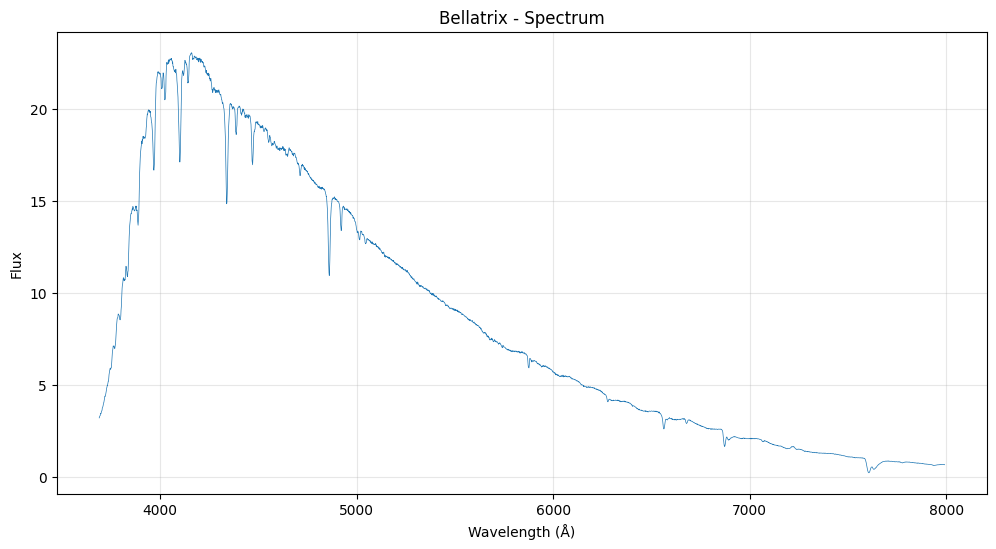
Click image to open in new tab for zooming
Observation Image
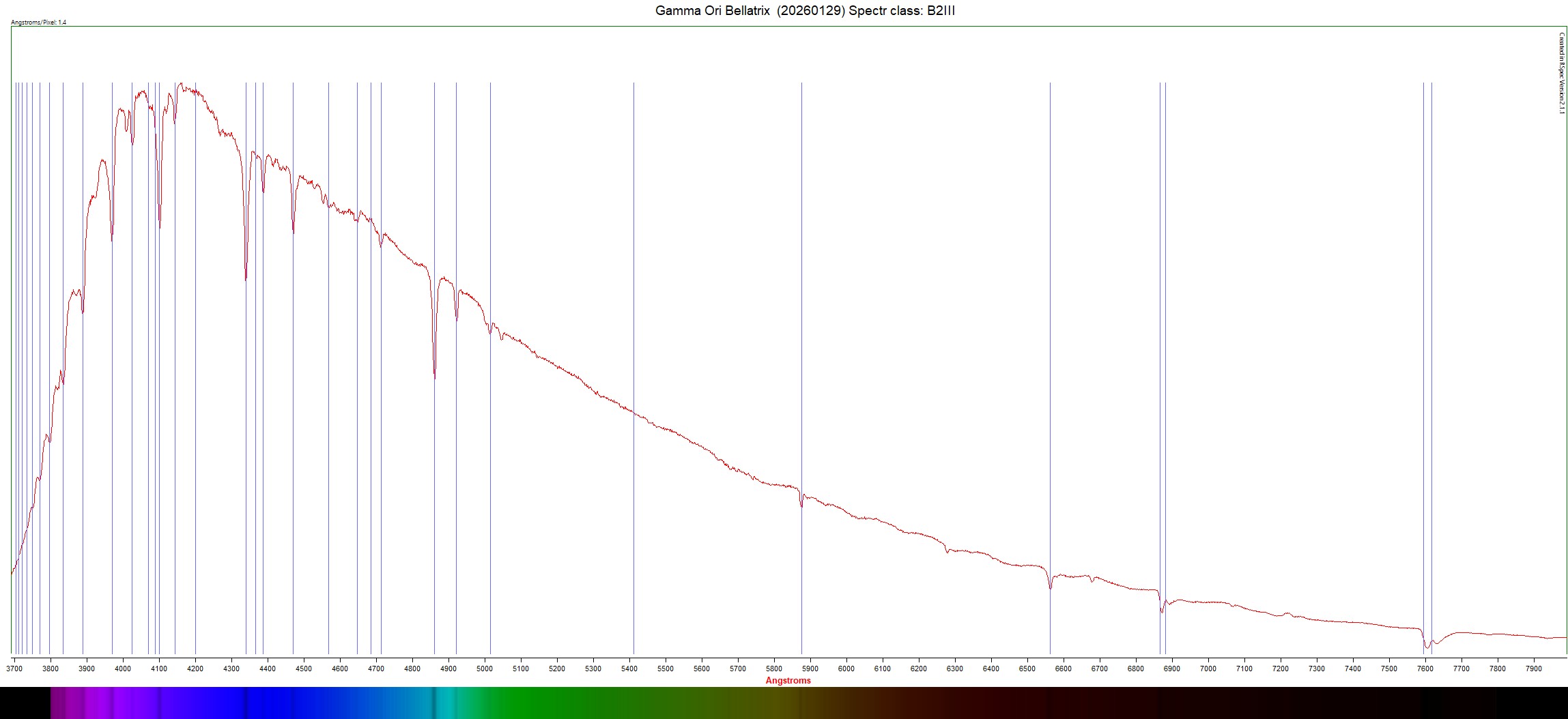
Click image to open in new tab for zooming
Metadata
| Field | Value |
|---|---|
| Object Name | Bellatrix |
| Observer | GDAA |
| Site | Sandvreten Observatory |
| Equipment | T41 - Config 1 (200L/mm) |
| Observation Date | 2026-01-31 12:53 |
| Julian Date | 2461072.03681 |
| Created | 2026-01-31 12:53 |
| Updated | 2026-02-11 16:06 |
Notes
Gamma Ori. The spectral types for O and early B stars were defined more rigorously in 1971 and Bellatrix was used as a standard for the B2 III type.[5] The expected brightness of Bellatrix from this spectral type is about one magnitude brighter than calculated from its apparent magnitude and Hipparcos distance.[23] Analysis of the observed characteristics of the star indicate that it should be a B2 main sequence star, not the giant that it appears from its spectral type.[6] Close analysis of high resolution spectra suggest that it is a spectroscopic binary composed of two similar stars less luminous than a B2 giant.[24] Bellatrix is a massive star with about 8.6 times the mass[9] and 6.4 times the radius of the Sun.[10] As a massive star, this star will evolve faster than the Sun, currently it has an estimated age of approximately 25 million years.[9] The hydrogen should be exhausted in seven million years, after that Bellatrix will expand and cool. It may end its life in a supernova.[25] The effective temperature of the outer envelope of this star is 22,000 K,[11] which is considerably hotter than the 5,772 K on the Sun. This high temperature gives this star the blue-white hue that occurs with B-type stars.[26] It shows a projected rotational velocity of around 52 km/s.[27]