Gamma Cet
Observer: GDAA
Spectrum Data
FITS Header Metadata
Show FITS Header
| Key | Value |
|---|---|
| SIMPLE | True |
| BITPIX | -32 |
| NAXIS | 1 |
| NAXIS1 | 3400 |
| CRPIX1 | 1 |
| CDELT1 | 1.46403188725085 |
| CRVAL1 | 3812.16284179688 |
| CTYPE1 | Wavelength |
| CUNIT1 | Angstrom |
| SWCREATE | RSpec 2.3.1.76 |
| VERSION | RSpec 2.3.1.76 |
| OBSERVER | DGRA |
| BSS_SITE | Sandvreten Observatory |
| BSS_INST | T41 |
| OBJNAME | Gamma Ceti |
| DATE-OBS | 2026-02-19T17:30:59 |
| EXPTIME | 480 |
| BSS_VHEL | 0 |
FITS Spectral Image
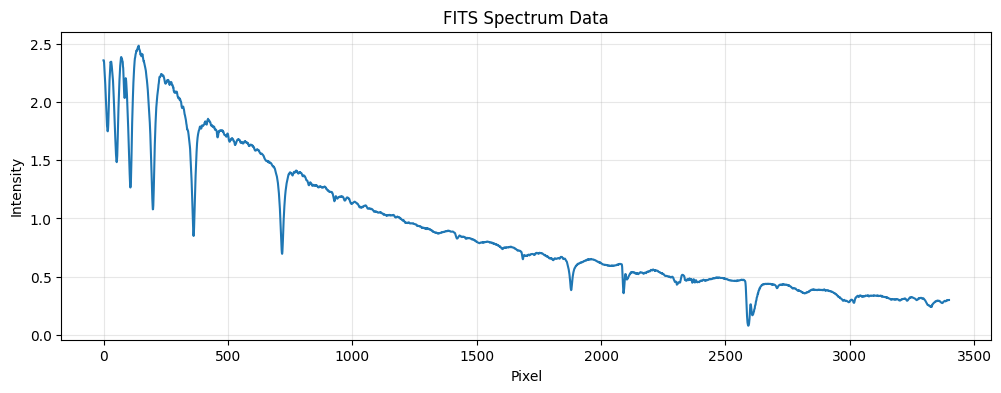
Click image to open in new tab for zooming
Calibrated Spectrum
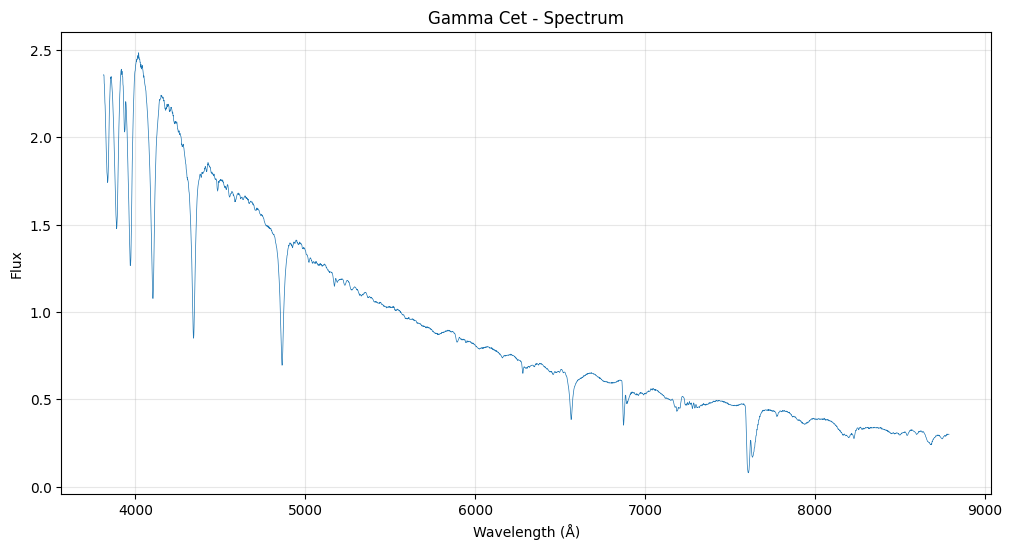
Click image to open in new tab for zooming
Observation Image
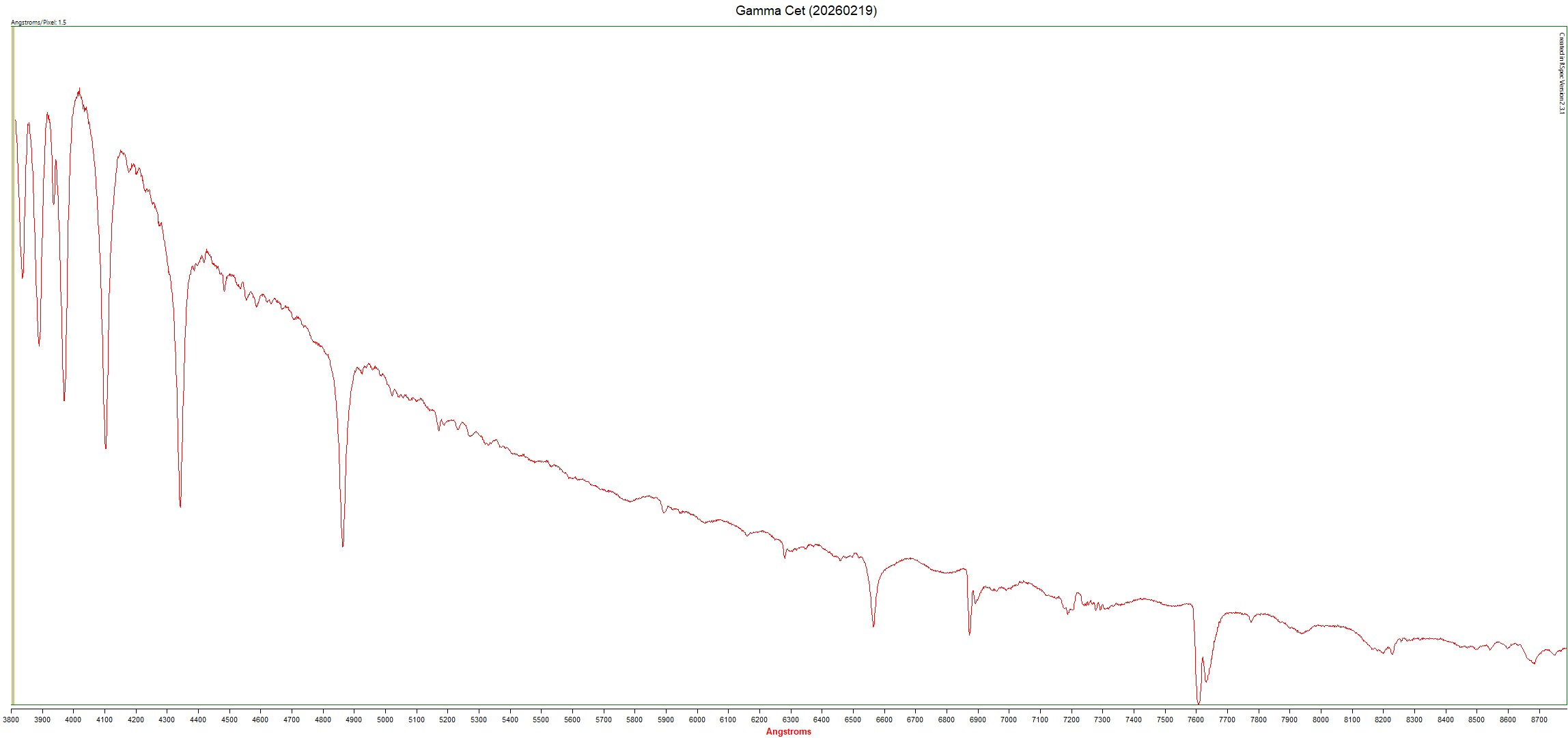
Click image to open in new tab for zooming
Metadata
| Field | Value |
|---|---|
| Object Name | Gamma Cet |
| Observer | GDAA |
| Site | Sandvreten Observatory |
| Equipment | T41 - Config 1 (200L/mm) |
| Observation Date | 2026-02-19 17:31 |
| Julian Date | 2461091.22986 |
| Exposure Time | 480.0 seconds |
| Created | 2026-02-21 16:18 |
| Updated | 2026-02-21 16:18 |
Notes
Gamma Ceti appears to be a triple star system.[18] The inner pair (A and B) have an angular separation of 2.6 arcseconds. The primary component of this pair (A) is an A-type main sequence star with a stellar classification of A3 V and a visual magnitude of 3.6. The fainter secondary component (B) is an F-type main sequence star that has a classification of F3 V and a magnitude of 6.6.[4] The contrasting colors of these two stars makes them a popular target of amateur astronomers. The two can be resolved with a small, 4 in (10 cm) aperture telescope under ideal seeing conditions, although at times they can be a challenge to resolve even with a much larger scope. (source: Wikipedia)