Tianguan
Observer: GDAA
Spectrum Data
FITS Header Metadata
Show FITS Header
| Key | Value |
|---|---|
| SIMPLE | True |
| BITPIX | -32 |
| NAXIS | 1 |
| NAXIS1 | 2961 |
| CRPIX1 | 1 |
| CDELT1 | 1.45255324904983 |
| CRVAL1 | 3691.13232421875 |
| CTYPE1 | Wavelength |
| CUNIT1 | Angstrom |
| SWCREATE | RSpec 2.3.1.76 |
| VERSION | RSpec 2.3.1.76 |
| OBSERVER | DGRA |
| BSS_SITE | Sandvreten Observatory |
| BSS_INST | T41 |
| OBJNAME | zeta tau |
| DATE-OBS | 2026-02-03T18:59:45 |
| EXPTIME | 720 |
| BSS_VHEL | 0 |
FITS Spectral Image
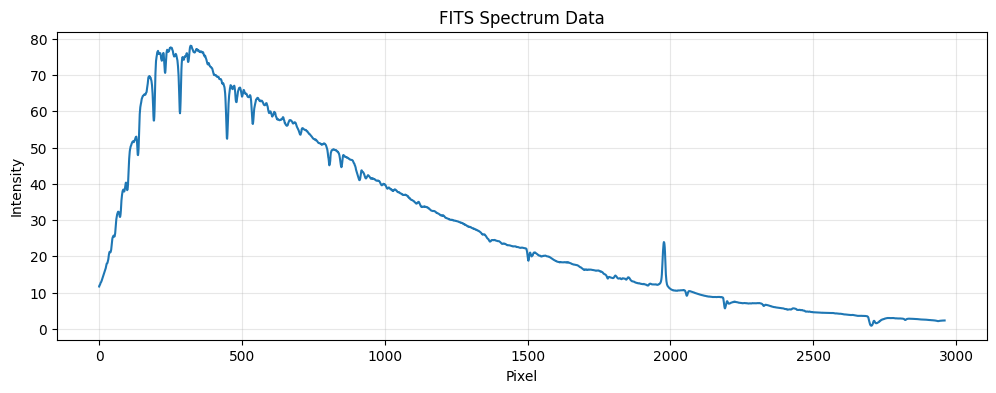
Click image to open in new tab for zooming
Calibrated Spectrum
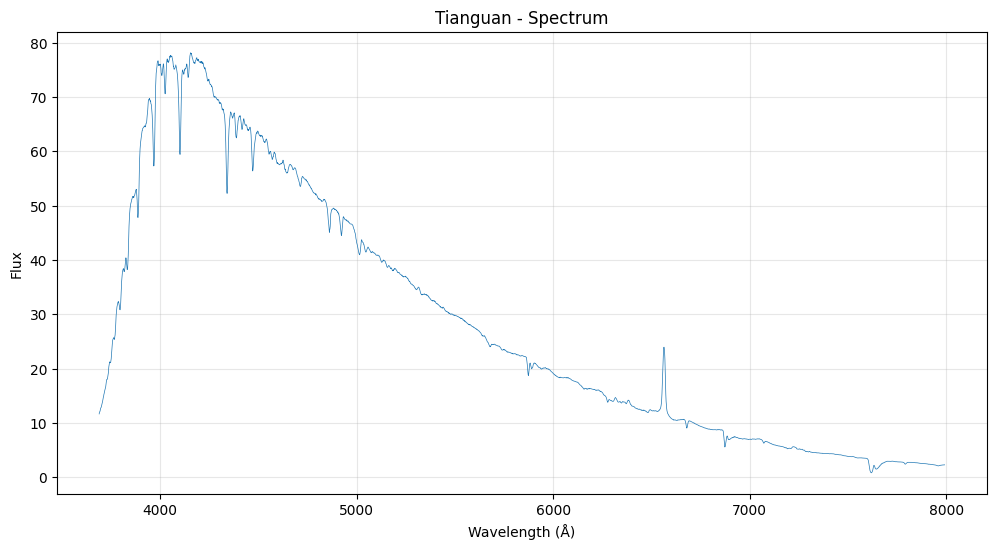
Click image to open in new tab for zooming
Observation Image
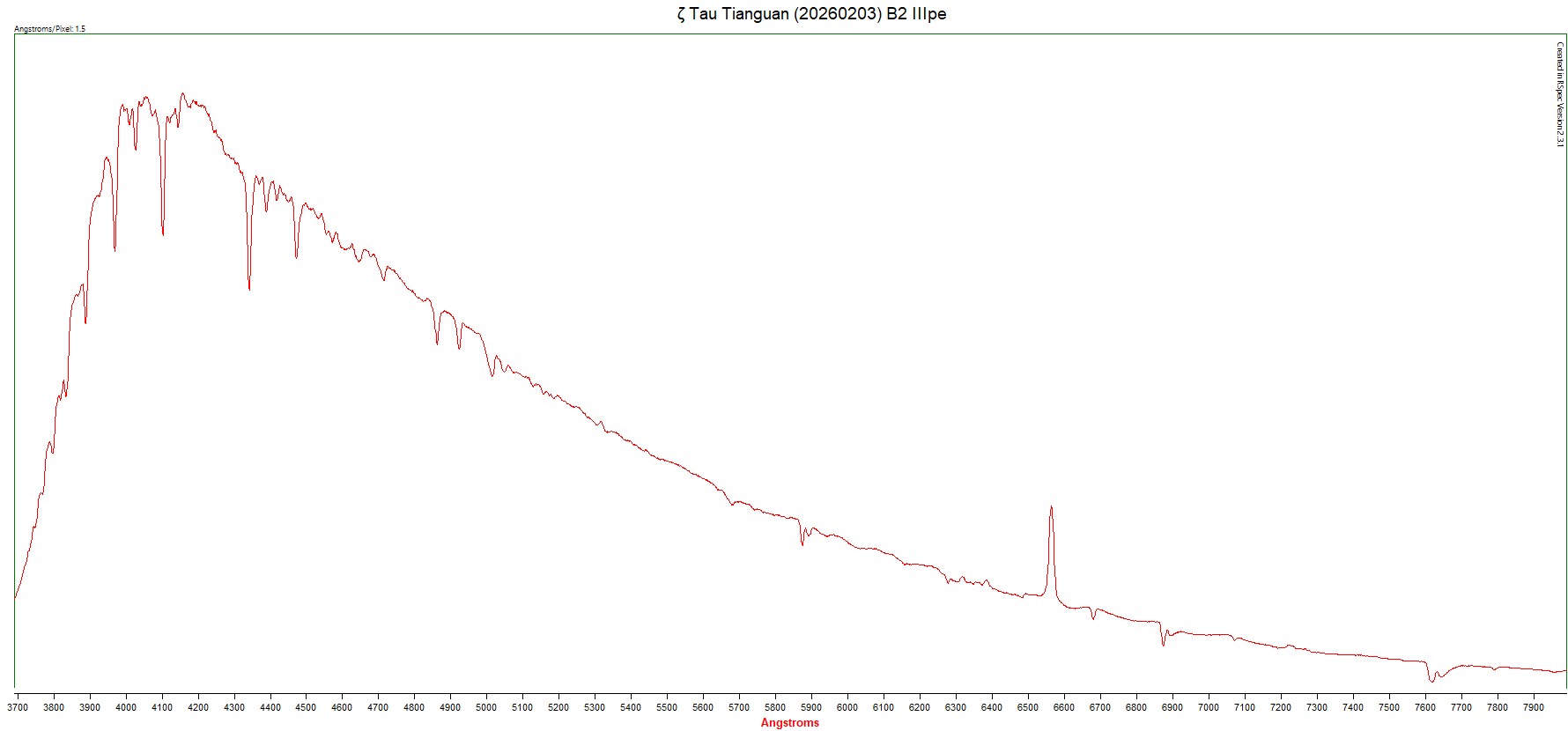
Click image to open in new tab for zooming
Metadata
| Field | Value |
|---|---|
| Object Name | Tianguan |
| Observer | GDAA |
| Site | Sandvreten Observatory |
| Equipment | T41 - Config 1 (200L/mm) |
| Observation Date | 2026-02-03 18:59 |
| Julian Date | 2461075.29097 |
| Exposure Time | 720.0 seconds |
| Created | 2026-02-22 10:25 |
| Updated | 2026-02-22 10:26 |
Notes
Zeta Tauri is a single-lined spectroscopic binary system, which means the two components are orbiting so close to each other that they can not be resolved with a telescope. Instead, the orbital motion of the primary component is indicated by Doppler effect shifts in the absorption lines in its spectrum. The two components are separated by an estimated distance of about 1.17 astronomical units, or 117% of the distance from the Earth to the Sun. They are following circular orbits with a period of nearly 133 days.[4] Compared to the Sun, the primary, Zeta Tauri A, is an enormous star with more than 11 times the mass and 5–6 times the radius.[4] It is rotating rapidly with a projected rotational velocity of 125 km s−1.[8] The spectrum of the primary component has a stellar classification of B2 IIIpe.[4] A luminosity class of 'III' indicates this is a giant star that has exhausted the hydrogen at its core and evolved away from the main sequence. The 'p' suffix indicates an unspecified chemical peculiarity in the spectrum, while 'e' is used for stars that display emission lines. For Be stars such as this, the emission lines are produced by a rotating circumstellar disk of gas, made of material that has been ejected from the star's outer envelope. An oscillatory pattern in this spectrum is being caused by a single-armed spiral density wave in the disk. The disk may be precessing from the gravitational influence of the secondary component.[4] The companion, Zeta Tauri B, has about 94% the mass of the Sun.[4] It has been proposed that Zeta Tauri B is a white dwarf accreting the mass ejected from its Be star companion; this would explain its hard X-ray (source:Wikipedia)