Alpheratz
Observer: GDAA
Spectrum Data
FITS Header Metadata
Show FITS Header
| Key | Value |
|---|---|
| SIMPLE | True |
| BITPIX | -32 |
| NAXIS | 1 |
| NAXIS1 | 2754 |
| CRPIX1 | 1 |
| CDELT1 | 1.45258067193743 |
| CRVAL1 | 3800.46044921875 |
| CTYPE1 | Wavelength |
| CUNIT1 | Angstrom |
| SWCREATE | RSpec 2.3.1.76 |
| VERSION | RSpec 2.3.1.76 |
| OBSERVER | DGRA |
| BSS_SITE | Sandvreten Observatory |
| BSS_INST | T41 |
| OBJNAME | alp And |
| DATE-OBS | 2026-02-03T16:59:40 |
| EXPTIME | 60 |
| BSS_VHEL | 0 |
FITS Spectral Image
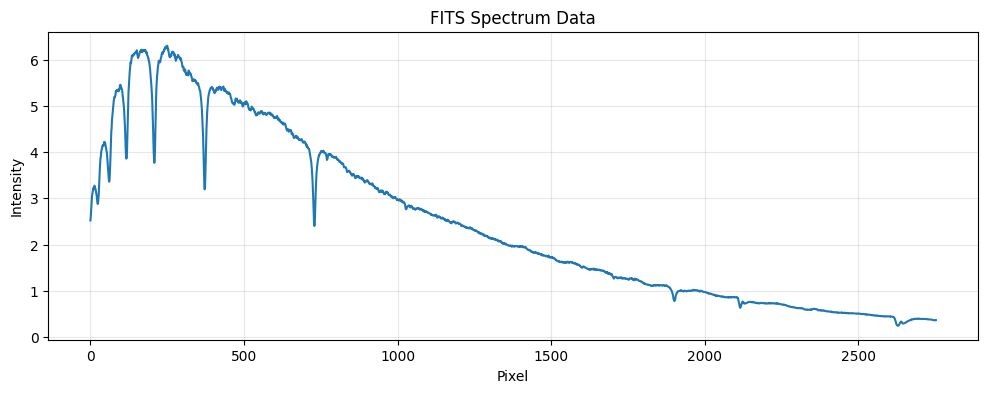
Click image to open in new tab for zooming
Calibrated Spectrum
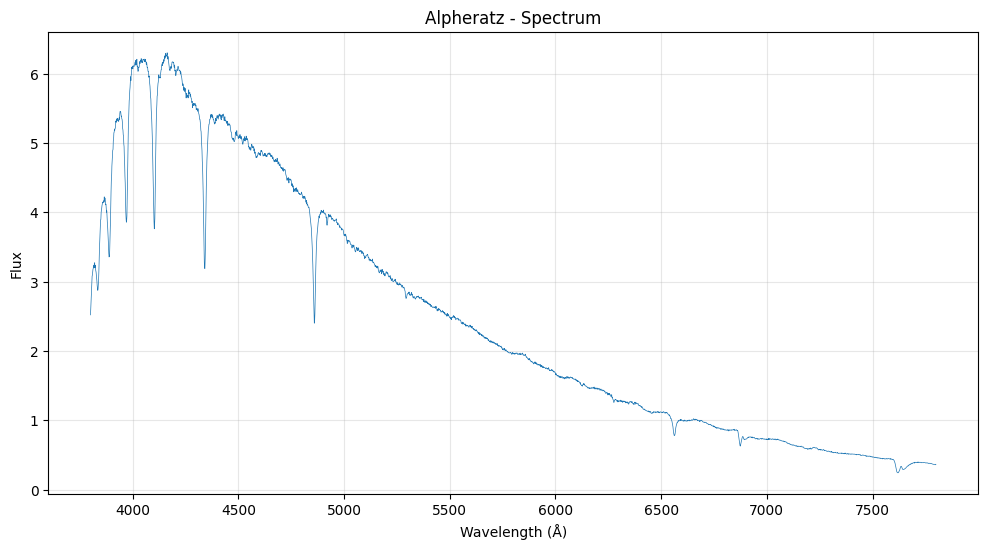
Click image to open in new tab for zooming
Observation Image
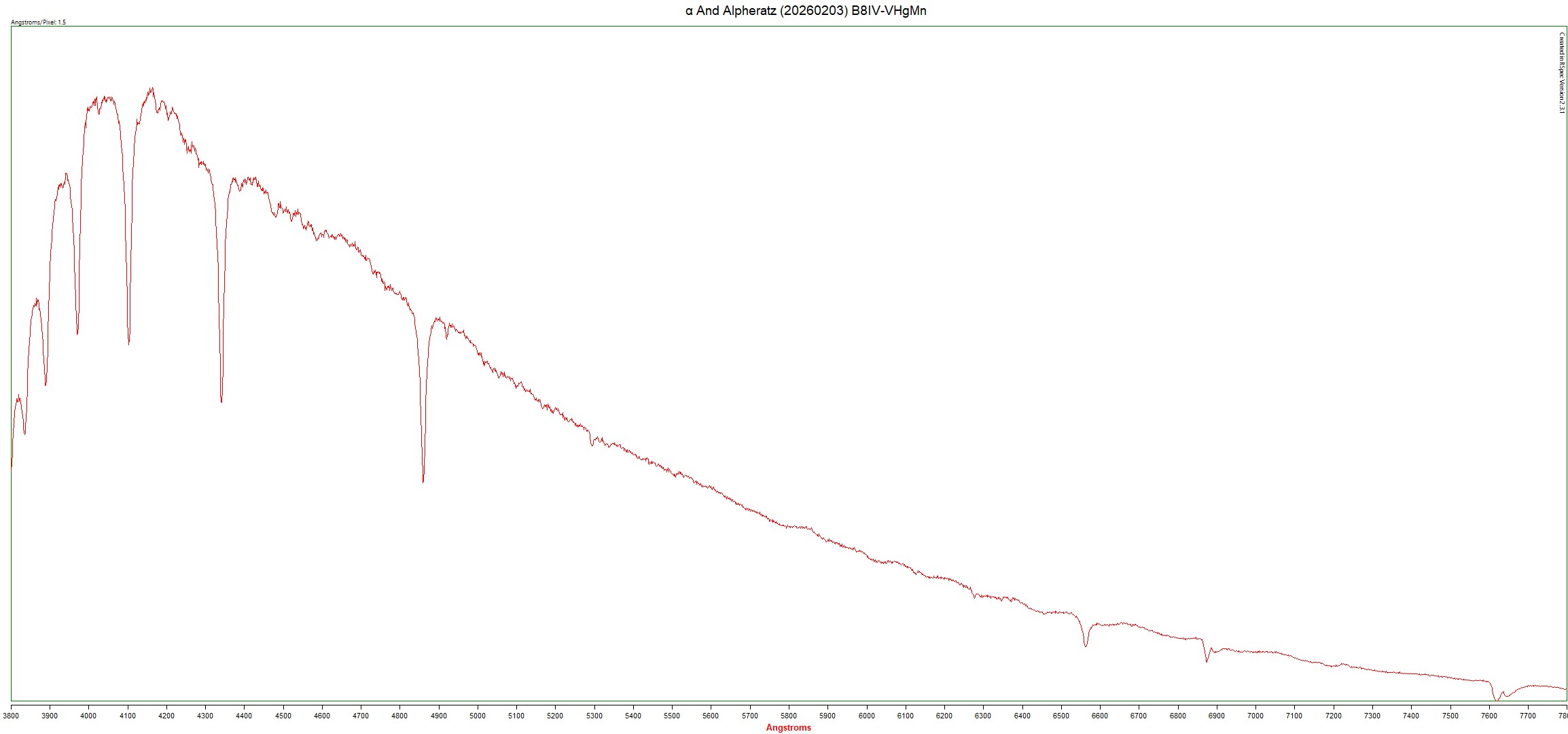
Click image to open in new tab for zooming
Metadata
| Field | Value |
|---|---|
| Object Name | Alpheratz |
| Observer | GDAA |
| Site | Sandvreten Observatory |
| Equipment | T41 - Config 1 (200L/mm) |
| Observation Date | 2026-02-03 16:59 |
| Julian Date | 2461075.20764 |
| Exposure Time | 60.0 seconds |
| Created | 2026-02-22 10:51 |
| Updated | 2026-02-22 10:51 |
Notes
Alpha And. The two stars are now known to orbit each other with a period of 96.9 days.[7] The larger, brighter star, called the primary, has a spectral type of B8IV-VHgMn,[30] a mass of approximately 3.6 solar masses,[7] a surface temperature of about 11,900 K (or 13,850 K[10]), and, measured over all wavelengths, a luminosity of about 160 times the Sun's.[5] Its smaller, fainter companion, the secondary, has a mass of approximately 1.9 solar masses[7] and a surface temperature of about 7,900 K, and, again measured over all wavelengths, a luminosity of about 15 times the Sun's. It is a late-type A star whose spectral type is estimated as A7V. (source: Wikipedia)