Almaaz
Observer: GDAA
Spectrum Data
FITS Header Metadata
Show FITS Header
| Key | Value |
|---|---|
| SIMPLE | True |
| BITPIX | -32 |
| NAXIS | 1 |
| NAXIS1 | 4145 |
| CRPIX1 | 1 |
| CDELT1 | 1.49709499756802 |
| CRVAL1 | 3781.61938476563 |
| CTYPE1 | Wavelength |
| CUNIT1 | Angstrom |
| SWCREATE | RSpec 2.3.1.76 |
| VERSION | RSpec 2.3.1.76 |
| OBSERVER | DGRA |
| BSS_SITE | Sandvreten Observatory |
| BSS_INST | T41 |
| OBJNAME | Epsilon Aur |
| DATE-OBS | 2026-02-19T19:18:12 |
| EXPTIME | 360 |
| BSS_VHEL | 0 |
FITS Spectral Image
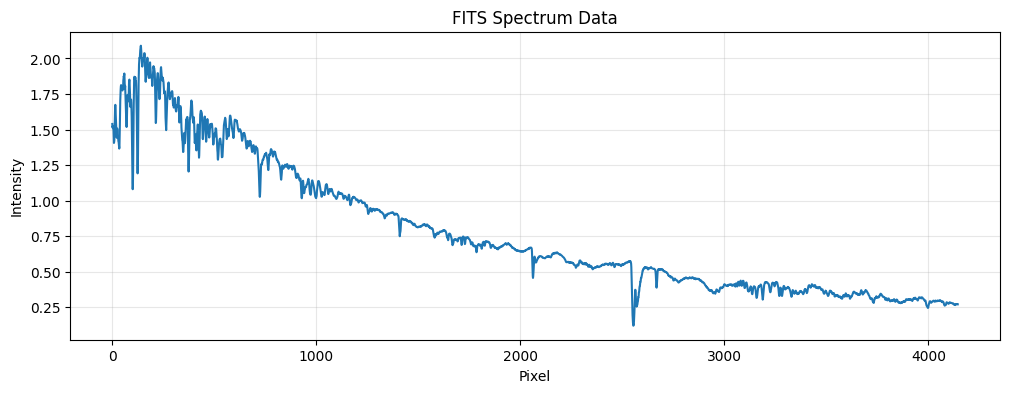
Click image to open in new tab for zooming
Calibrated Spectrum
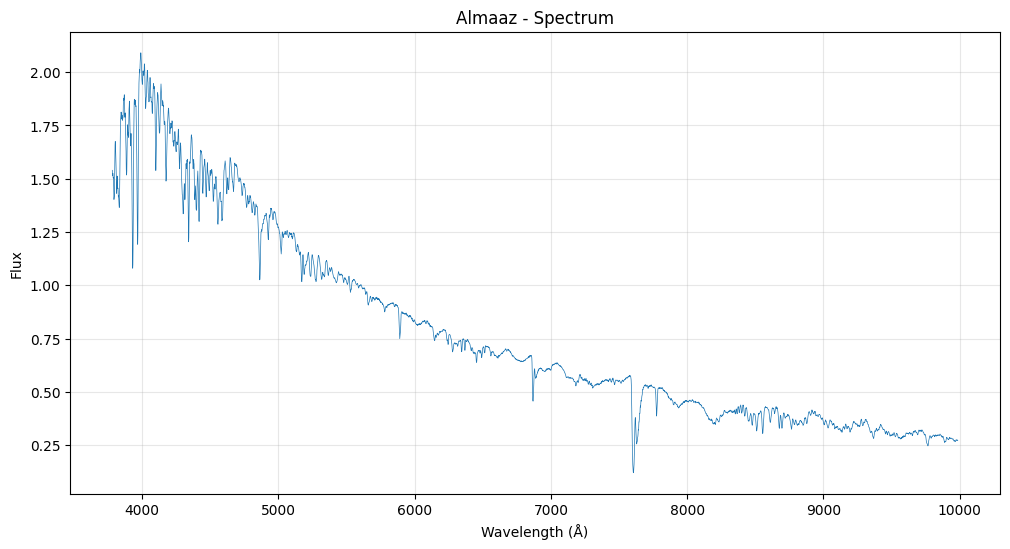
Click image to open in new tab for zooming
Observation Image
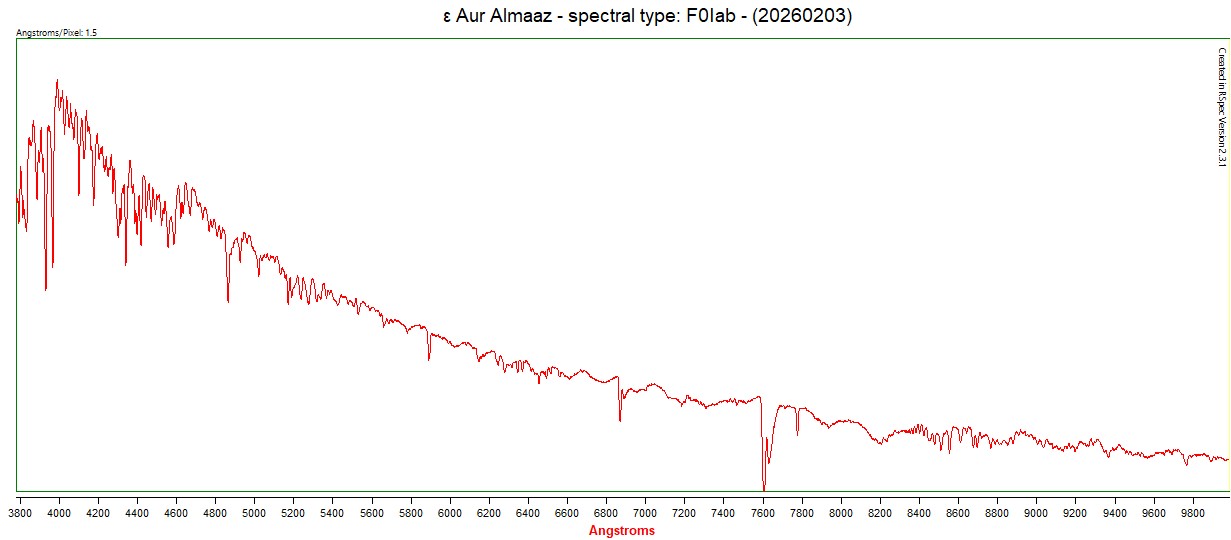
Click image to open in new tab for zooming
Metadata
| Field | Value |
|---|---|
| Object Name | Almaaz |
| Observer | GDAA |
| Site | Sandvreten Observatory |
| Equipment | T41 - Config 1 (200L/mm) |
| Observation Date | 2026-02-19 19:18 |
| Julian Date | 2461091.30417 |
| Exposure Time | 360.0 seconds |
| Created | 2026-02-26 18:47 |
| Updated | 2026-02-26 18:47 |
Notes
Epsilon Aur. The nature of the Epsilon Aurigae system is unclear. It has long been known to consist of at least two components which undergo periodic eclipses with an unusual flat-bottomed dimming every 27 years. Early explanations with exceptionally large diffuse stars, black holes, and odd doughnut-shaped discs are no longer accepted. There are now two main explanations that can account for the known observed characteristics: a high mass model where the primary is a yellow supergiant of around 15 M☉; and a low mass model where the primary is about 2 M☉ and a less luminous evolved star.[11] Variations on the high mass model have always been popular, since the primary star is to all appearances a large supergiant star. Spectroscopically it is early F or late A with luminosity class Ia or Iab. Distance estimates consistently lead to luminosities expected for a bright supergiant, although there is a huge variation in published values for the distance. (source: Wikipedia)