Tiansi
Observer: GDAA
Spectrum Data
FITS Header Metadata
Show FITS Header
| Key | Value |
|---|---|
| SIMPLE | True |
| BITPIX | -32 |
| NAXIS | 1 |
| NAXIS1 | 2802 |
| CRPIX1 | 1 |
| CDELT1 | 1.45480330336822 |
| CRVAL1 | 3918.76684570313 |
| CTYPE1 | Wavelength |
| CUNIT1 | Angstrom |
| SWCREATE | RSpec 2.3.1.76 |
| VERSION | RSpec 2.3.1.76 |
| OBSERVER | DGRA |
| BSS_SITE | Sandvreten Observatory |
| BSS_INST | T41 |
| OBJNAME | Gamma Cas |
| DATE-OBS | 2026-02-03T18:15:47 |
| EXPTIME | 120 |
| BSS_VHEL | 0 |
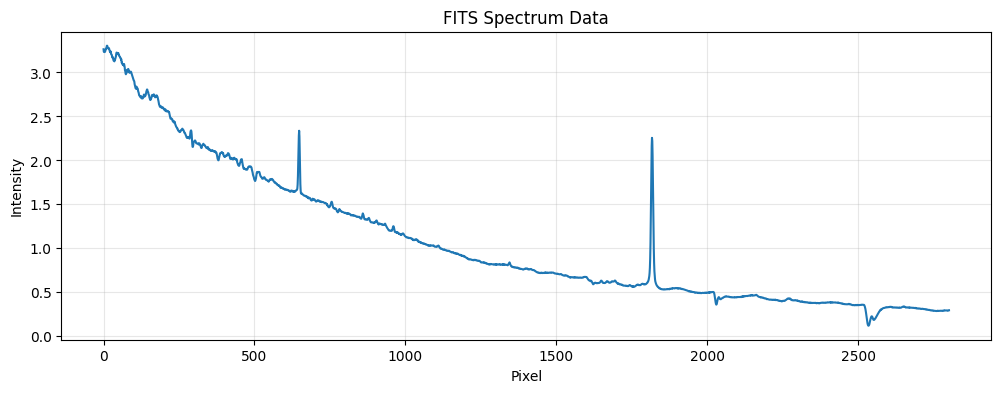
FITS Spectral Image
Click image to open in new tab for zooming
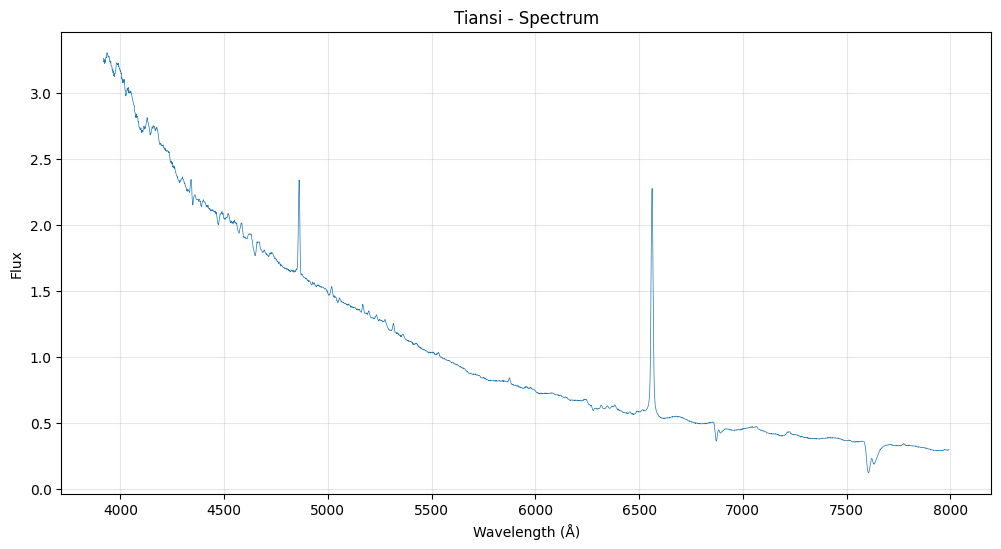
Calibrated Spectrum
Click image to open in new tab for zooming
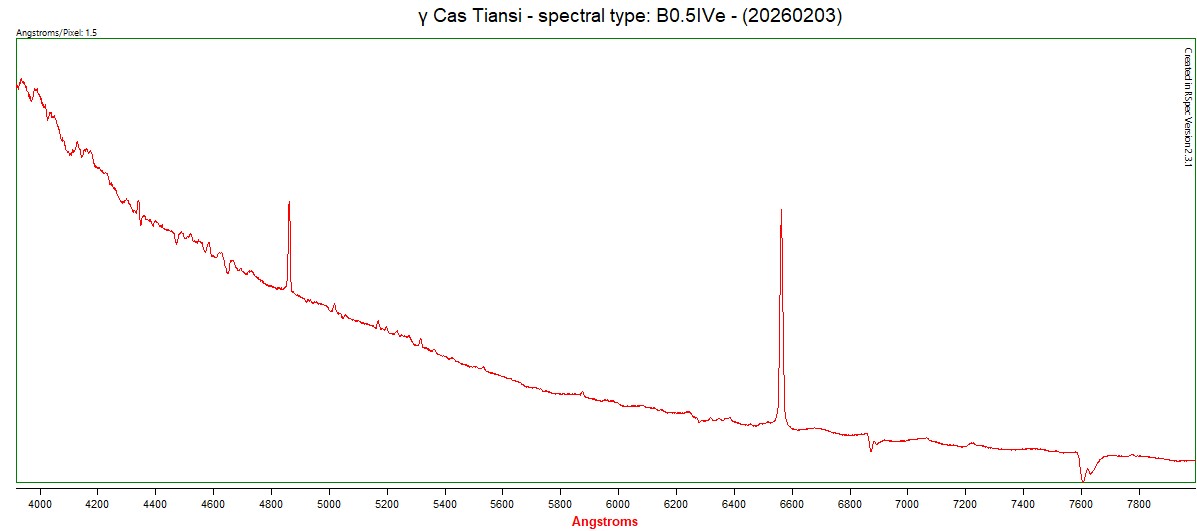
Observation Image
Click image to open in new tab for zooming
Metadata
| Field | Value |
|---|---|
| Object Name | Tiansi |
| Observer | GDAA |
| Site | Sandvreten Observatory |
| Equipment | T41 - Config 1 (200L/mm) |
| Observation Date | 2026-02-03 18:15 |
| Julian Date | 2461075.26042 |
| Exposure Time | 120.0 seconds |
| Created | 2026-03-07 17:24 |
| Updated | 2026-03-08 06:56 |
Notes
Gamma Cassiopeiae is an eruptive variable star. It is the prototype of the class of Gamma Cassiopeiae variable stars. The spectrum of this massive star matches a stellar classification of B0.5 IVe. The 'e' suffix is used for stars that show emission lines of hydrogen in the spectrum, caused in this case by the circumstellar disk. This places it among a category known as Be stars; in fact, the first such star ever to be so designated.[30] A luminosity class of IV suggest it is a subgiant star that has reached a stage of its evolution where it is exhausting the supply of hydrogen in its core region and transforming into a giant star, although it is modelled to be only about a third of the way through its main-sequence life[5] after a relatively brief 8 million years.[15] The outer atmosphere has an intense effective temperature of 25,000 K, which is causing it to glow with a blue-white hue. It has 17 times the Sun's mass and is radiating as much energy as 19,000 Suns.