Regulus
Observer: GDAA
Spectrum Data
FITS Header Metadata
Show FITS Header
| Key | Value |
|---|---|
| SIMPLE | True |
| BITPIX | -32 |
| NAXIS | 1 |
| NAXIS1 | 2937 |
| CRPIX1 | 1 |
| CDELT1 | 1.44738062720857 |
| CRVAL1 | 3745.12377929688 |
| CTYPE1 | Wavelength |
| CUNIT1 | Angstrom |
| SWCREATE | RSpec 2.3.1.76 |
| VERSION | RSpec 2.3.1.76 |
| OBSERVER | DGRA |
| BSS_SITE | Sandvreten Observatory |
| BSS_INST | T41 |
| OBJNAME | Alp Leo |
| DATE-OBS | 2026-02-08T20:08:25 |
| EXPTIME | 60 |
| BSS_VHEL | 0 |
FITS Spectral Image
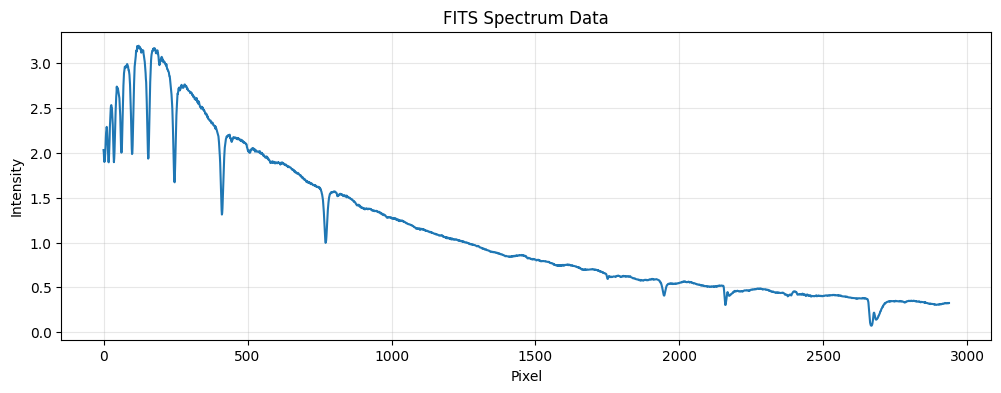
Click image to open in new tab for zooming
Calibrated Spectrum
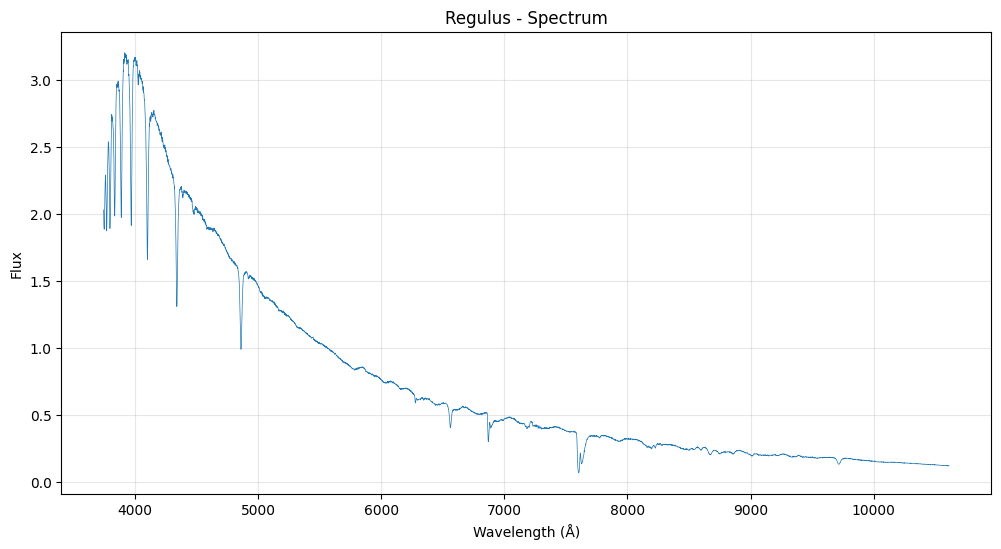
Click image to open in new tab for zooming
Observation Image
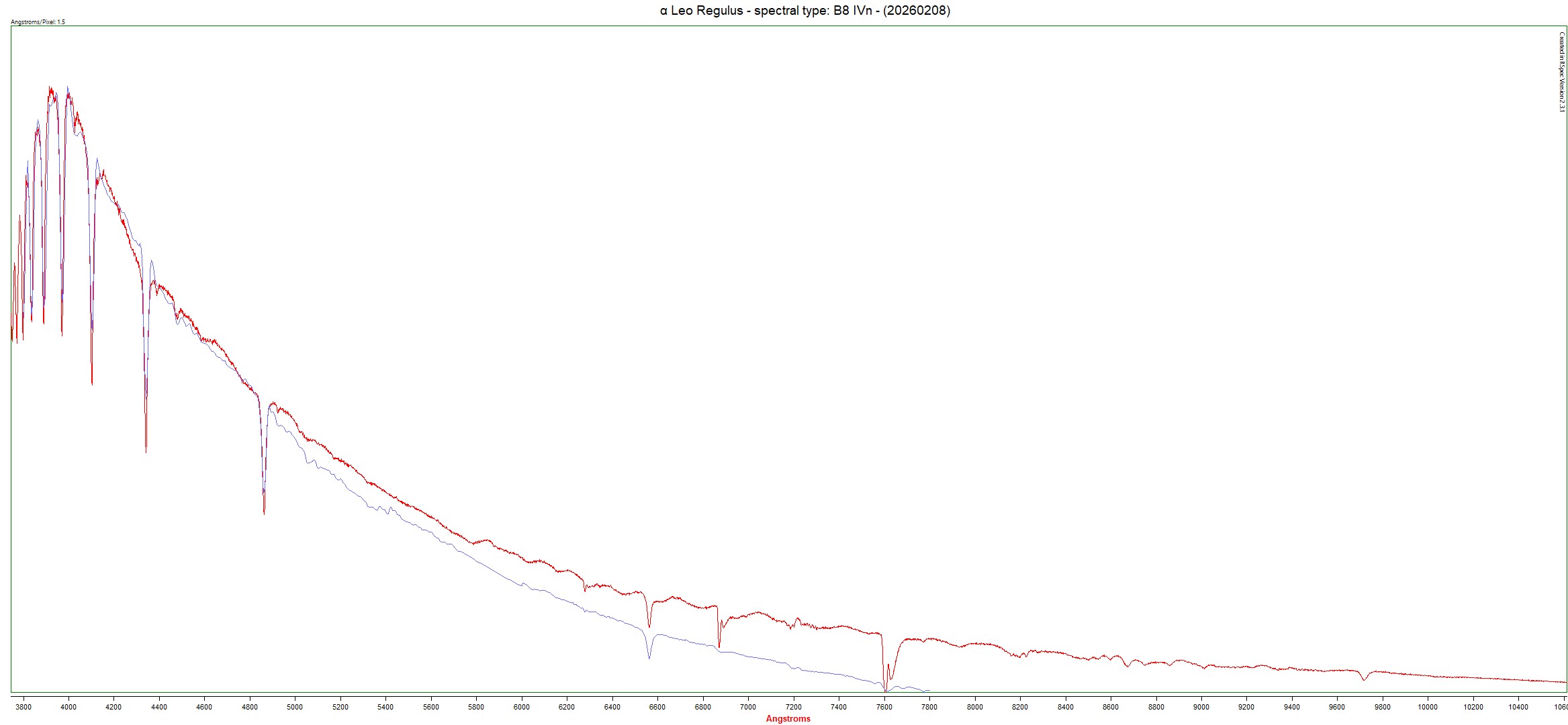
Click image to open in new tab for zooming
Metadata
| Field | Value |
|---|---|
| Object Name | Regulus |
| Observer | GDAA |
| Site | Sandvreten Observatory |
| Equipment | T41 - Config 1 (200L/mm) |
| Observation Date | 2026-02-08 20:08 |
| Julian Date | 2461080.33889 |
| Exposure Time | 60.0 seconds |
| Created | 2026-03-08 07:10 |
| Updated | 2026-03-08 07:14 |
Notes
Regulus is the brightest object in the constellation Leo and one of the brightest stars in the night sky. It has the Bayer designation designated α Leonis. The spectroscopic binary Regulus A consists of a blue-white main-sequence star and its companion, a pre-white dwarf. Regulus BC, also known as HD 87884, is separated from Regulus A by 176″ and is itself a close pair.Regulus is a multiple star system consisting of at least four stars and a substellar object. Regulus A is the dominant star, with a binary companion 177" distant that is thought to be physically related. Regulus D is a 12th magnitude companion at 212",[34] but is an unrelated background object.[35]