Dubhe
Observer: GDAA
Spectrum Data
FITS Header Metadata
Show FITS Header
| Key | Value |
|---|---|
| SIMPLE | True |
| BITPIX | -32 |
| NAXIS | 1 |
| NAXIS1 | 3648 |
| CRPIX1 | 1 |
| CDELT1 | 1.46128848143594 |
| CRVAL1 | 3663.61254882813 |
| CTYPE1 | Wavelength |
| CUNIT1 | Angstrom |
| SWCREATE | RSpec 2.3.1.76 |
| VERSION | RSpec 2.3.1.76 |
| OBSERVER | DGRA |
| BSS_SITE | Sandvreten Observatory |
| BSS_INST | T41 |
| OBJNAME | Alf UMa |
| DATE-OBS | 2026-03-03T20:04:52 |
| EXPTIME | 180 |
| BSS_VHEL | 0 |
FITS Spectral Image
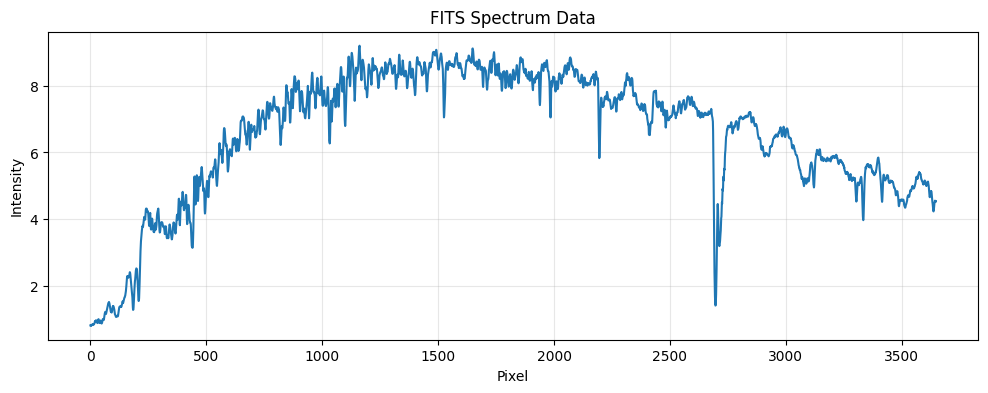
Click image to open in new tab for zooming
Calibrated Spectrum
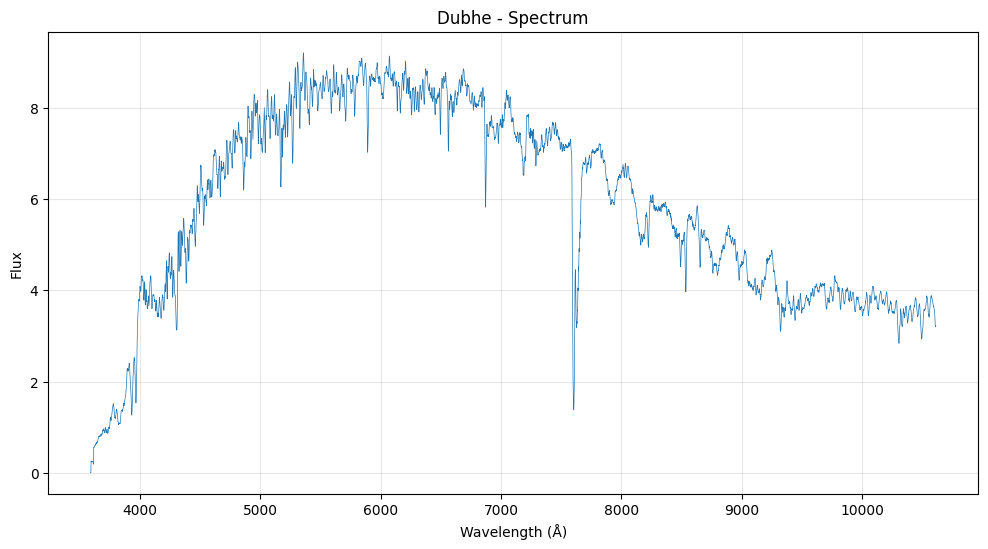
Click image to open in new tab for zooming
Observation Image
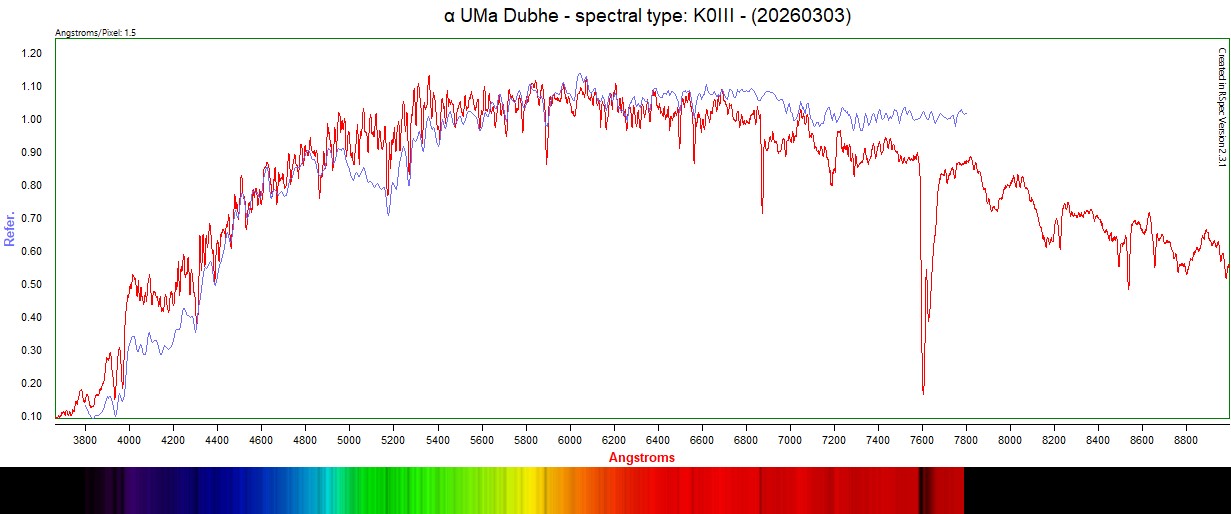
Click image to open in new tab for zooming
Metadata
| Field | Value |
|---|---|
| Object Name | Dubhe |
| Observer | GDAA |
| Site | Sandvreten Observatory |
| Equipment | T41 - Config 1 (200L/mm) |
| Observation Date | 2026-02-03 20:05 |
| Julian Date | 2461075.33681 |
| Exposure Time | 180.0 seconds |
| Created | 2026-03-09 16:41 |
| Updated | 2026-03-09 16:41 |
Notes
Dubhe is a spectroscopic binary made up of the stars α Ursae Majoris A and α Ursae Majoris B. The pair orbit at a separation of about 23 astronomical units (AU),[16] with a period of 44.5 years and an eccentricity of 0.44.[3] There is another spectroscopic binary at an angular separation of 7.1 arcminutes, forming a 7th magnitude pair showing an F8 spectral type with an orbital period of 6.035 days and an eccentricity of 0.09. It is sometimes referred to as Alpha Ursae Majoris C, but is separately catalogued as HD 95638.[16] Together they form a quadruple star system. Component A is the system's primary, and it has a stellar classification of K0III.[4] This is a giant star that has evolved away from the main sequence after consuming the hydrogen at its core. It is 280 million years old[10] with 3.7 times the Sun's mass[3] and has expanded 27 times the radius of the Sun.[8] The star is radiating 340 times the luminosity of the Sun from its enlarged photosphere[9] at an effective temperature of 4,800 K.[8] The secondary star, component B, is an A-type main-sequence star that has a class of A5V.[3] α Ursae Majoris has been reported to vary in brightness by about a thousandth of a magnitude. Ten radial oscillation modes have been detected, with periods between 6.4 hours and 6.4 days.[18]