Sirius
Observer: GDAA
Spectrum Data
FITS Header Metadata
Show FITS Header
| Key | Value |
|---|---|
| SIMPLE | True |
| BITPIX | -32 |
| NAXIS | 1 |
| NAXIS1 | 3543 |
| CRPIX1 | 1 |
| CDELT1 | 1.48193697118948 |
| CRVAL1 | 3750.43823242188 |
| CTYPE1 | Wavelength |
| CUNIT1 | Angstrom |
| SWCREATE | RSpec 2.3.1.76 |
| VERSION | RSpec 2.3.1.76 |
| OBSERVER | DGRA |
| BSS_SITE | Sandvreten Observatory |
| BSS_INST | T41 |
| OBJNAME | Alf CMa |
| DATE-OBS | 2026-03-09T18:22:34 |
| EXPTIME | 40 |
| BSS_VHEL | 0 |
FITS Spectral Image
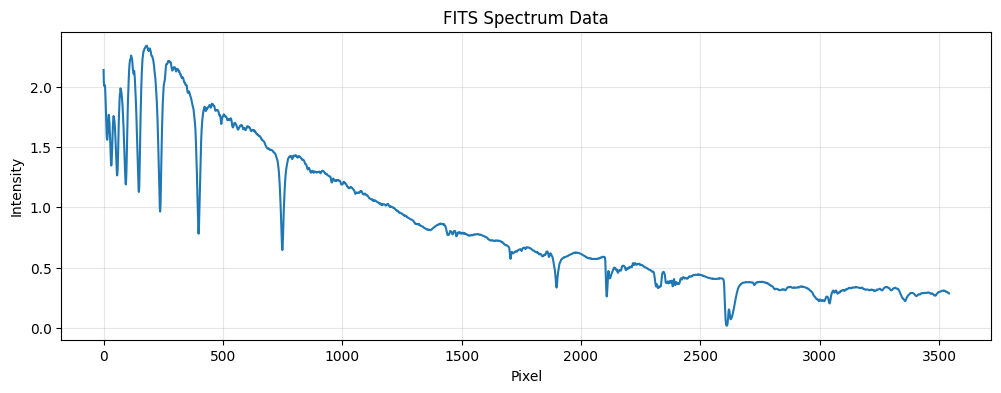
Click image to open in new tab for zooming
Calibrated Spectrum
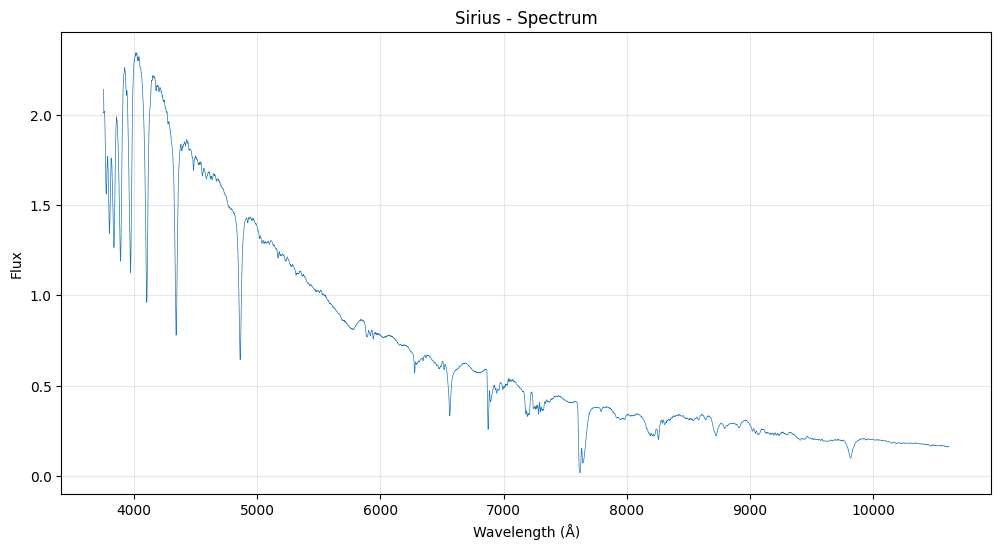
Click image to open in new tab for zooming
Observation Image
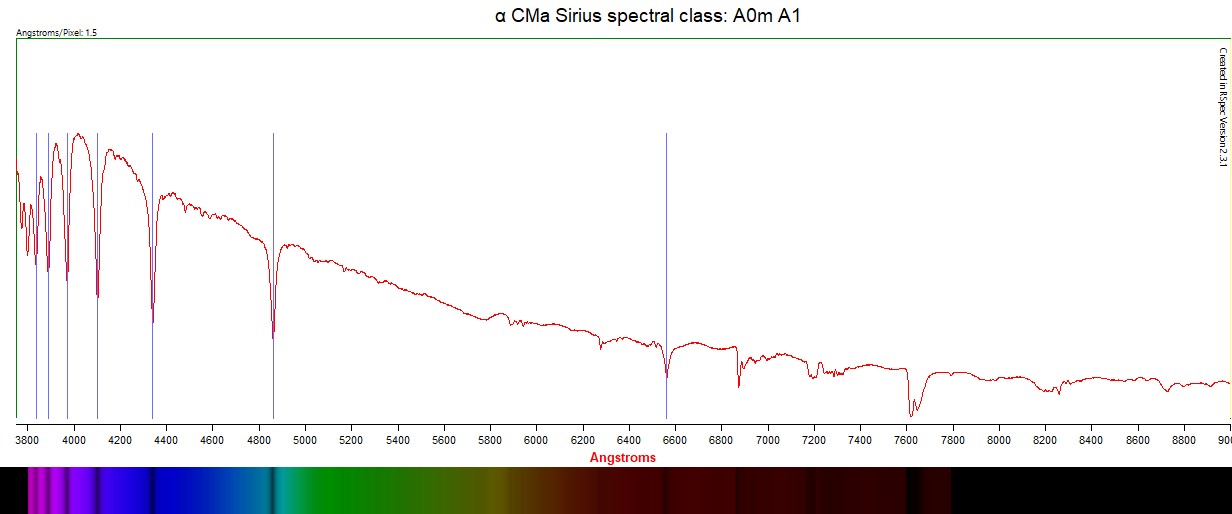
Click image to open in new tab for zooming
Metadata
| Field | Value |
|---|---|
| Object Name | Sirius |
| Observer | GDAA |
| Site | Sandvreten Observatory |
| Equipment | T41 - Config 1 (200L/mm) |
| Observation Date | 2026-03-09 18:22 |
| Julian Date | 2461109.26528 |
| Exposure Time | 40.0 seconds |
| Created | 2026-03-13 15:10 |
| Updated | 2026-03-13 15:10 |
Notes
Sirius A is about twice as massive as the Sun (M☉) and has an absolute visual magnitude of +1.43. It is 25 times as luminous as the Sun,[19] but has a significantly lower luminosity than other bright stars such as Canopus, Betelgeuse, and Rigel. The system is between 200 and 300 million years old.[19] It was originally composed of two bright bluish stars. The initially more massive of these, Sirius B, consumed its hydrogen fuel and became a red giant before shedding its outer layers and collapsing into its current state as a white dwarf around 120 million years ago.[19]