Mebsuta
Observer: GDAA
Spectrum Data
FITS Header Metadata
Show FITS Header
| Key | Value |
|---|---|
| SIMPLE | True |
| BITPIX | -32 |
| NAXIS | 1 |
| NAXIS1 | 3951 |
| CRPIX1 | 1 |
| CDELT1 | 1.48210956042326 |
| CRVAL1 | 3835.99731445313 |
| CTYPE1 | Wavelength |
| CUNIT1 | Angstrom |
| SWCREATE | RSpec 2.3.1.76 |
| VERSION | RSpec 2.3.1.76 |
| OBSERVER | HLAD |
| BSS_SITE | Sandvreten Observatory L11 |
| BSS_INST | T41 |
| OBJNAME | Eps Gem |
| DATE-OBS | 2026-03-10T19:20:10 |
| EXPTIME | 720 |
| BSS_VHEL | 0 |
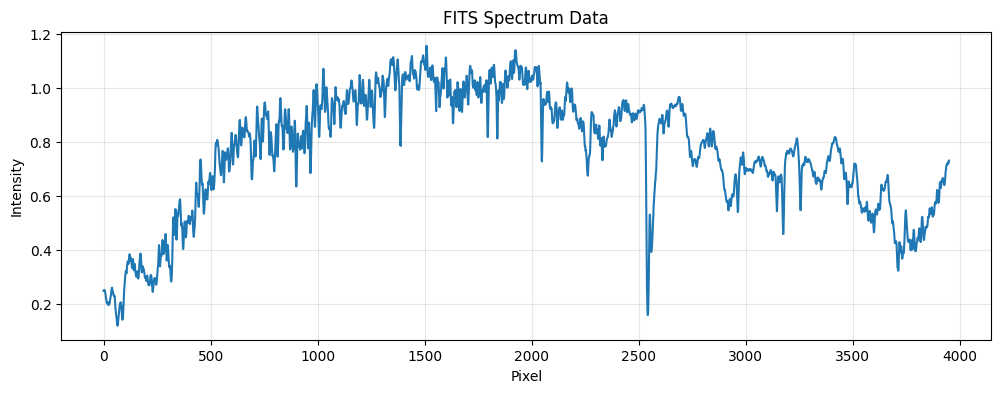
FITS Spectral Image
Click image to open in new tab for zooming
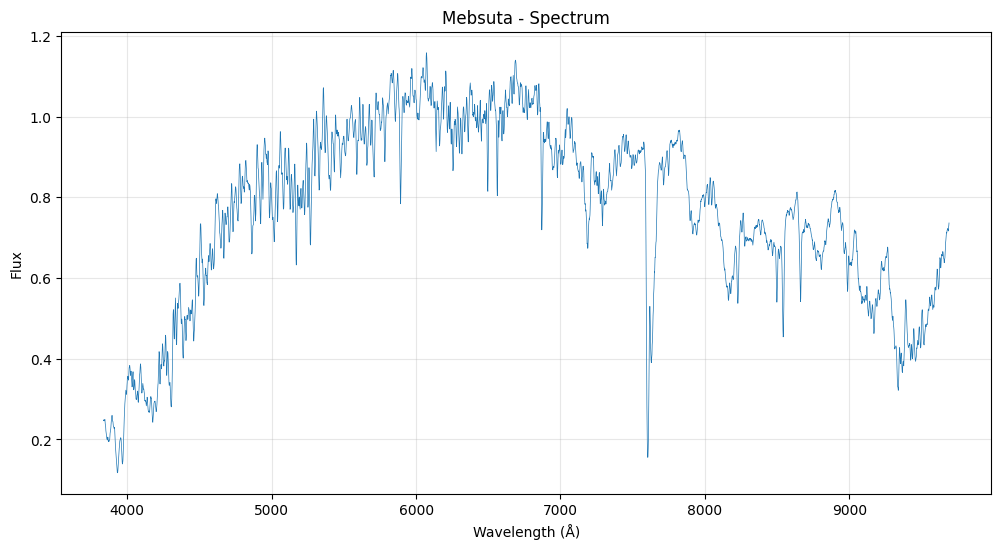
Calibrated Spectrum
Click image to open in new tab for zooming
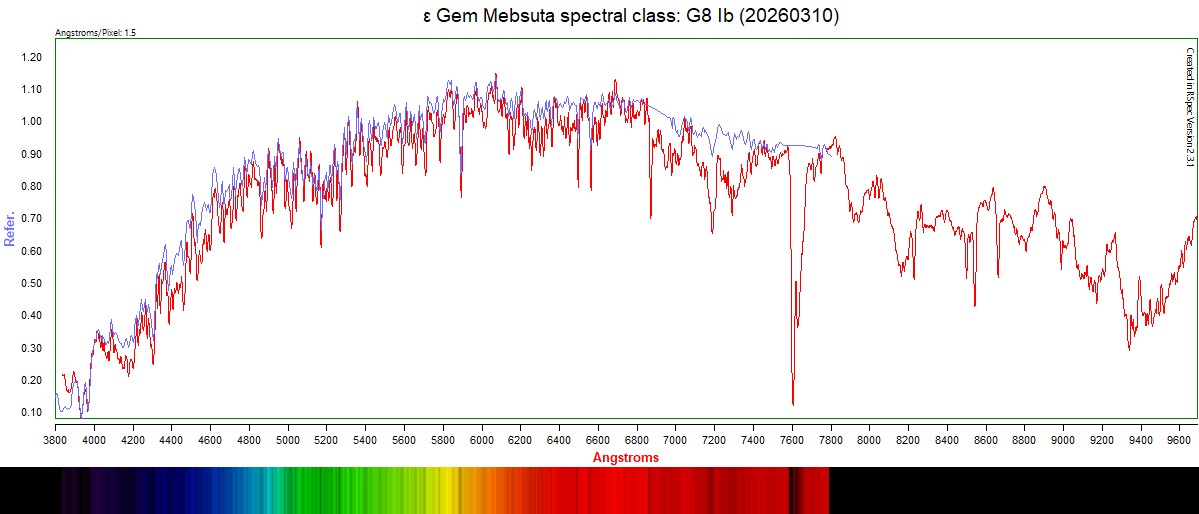
Observation Image
Click image to open in new tab for zooming
Metadata
| Field | Value |
|---|---|
| Object Name | Mebsuta |
| Observer | GDAA |
| Site | Sandvreten Observatory |
| Equipment | T41 - Config 1 (200L/mm) |
| Observation Date | 2026-03-10 19:20 |
| Julian Date | 2461110.30556 |
| Exposure Time | 720.0 seconds |
| Created | 2026-03-15 11:45 |
| Updated | 2026-03-15 11:45 |
Notes
Epsilon Geminorum. At Epsilon Geminorum's distance, extinction from interstellar dust is causing a magnitude reduction of 0.27.[7] The spectrum of this star matches a stellar classification of G8 Ib,[3] where the luminosity class of Ib indicates this is a lower luminosity supergiant star. Alternatively, it may be a star that has passed through the asymptotic giant branch stage and possesses a detached shell of dust.[19] It has 5.3 times the mass of the Sun and it is estimated to be 100 million years old.[8] Since 1943, the spectrum of this star has served as one of the stable anchor points by which other stars are classified. (source: Wikipedia)