Haedus II
Observer: GDAA
Spectrum Data
FITS Header Metadata
Show FITS Header
| Key | Value |
|---|---|
| SIMPLE | True |
| BITPIX | -32 |
| NAXIS | 1 |
| NAXIS1 | 3532 |
| CRPIX1 | 1 |
| CDELT1 | 1.46674183791773 |
| CRVAL1 | 3819.8984375 |
| CTYPE1 | Wavelength |
| CUNIT1 | Angstrom |
| SWCREATE | RSpec 2.3.1.76 |
| VERSION | RSpec 2.3.1.76 |
| OBSERVER | DGRA |
| BSS_SITE | Sandvreten Observatory |
| BSS_INST | T41 |
| OBJNAME | Eta Aur |
| DATE-OBS | 2026-03-17T19:33:16 |
| EXPTIME | 300 |
| BSS_VHEL | 0 |
FITS Spectral Image
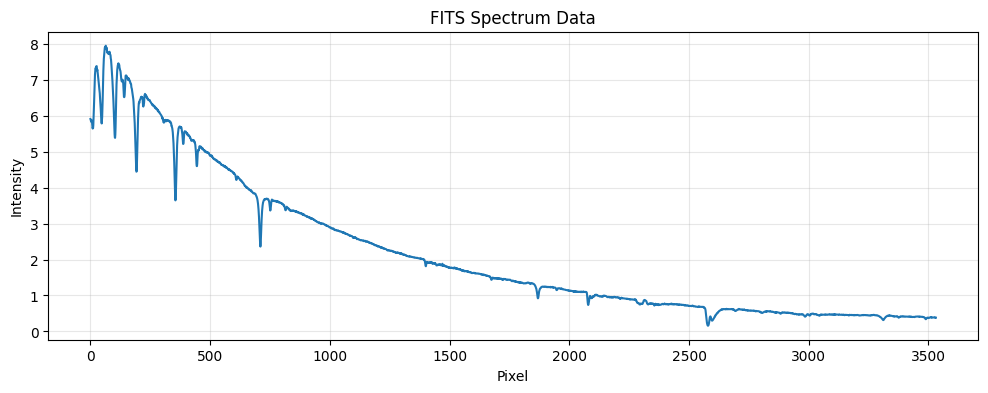
Click image to open in new tab for zooming
Calibrated Spectrum
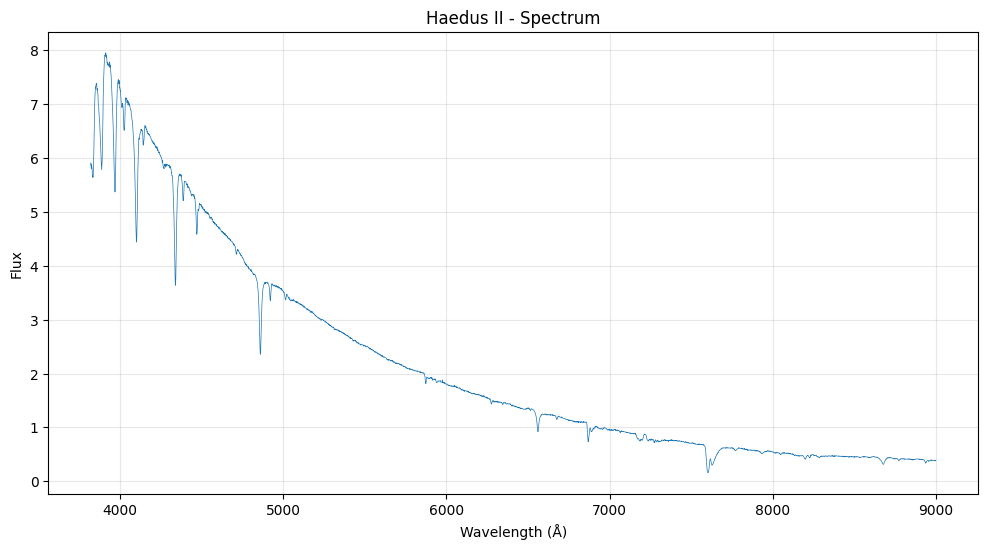
Click image to open in new tab for zooming
Observation Image
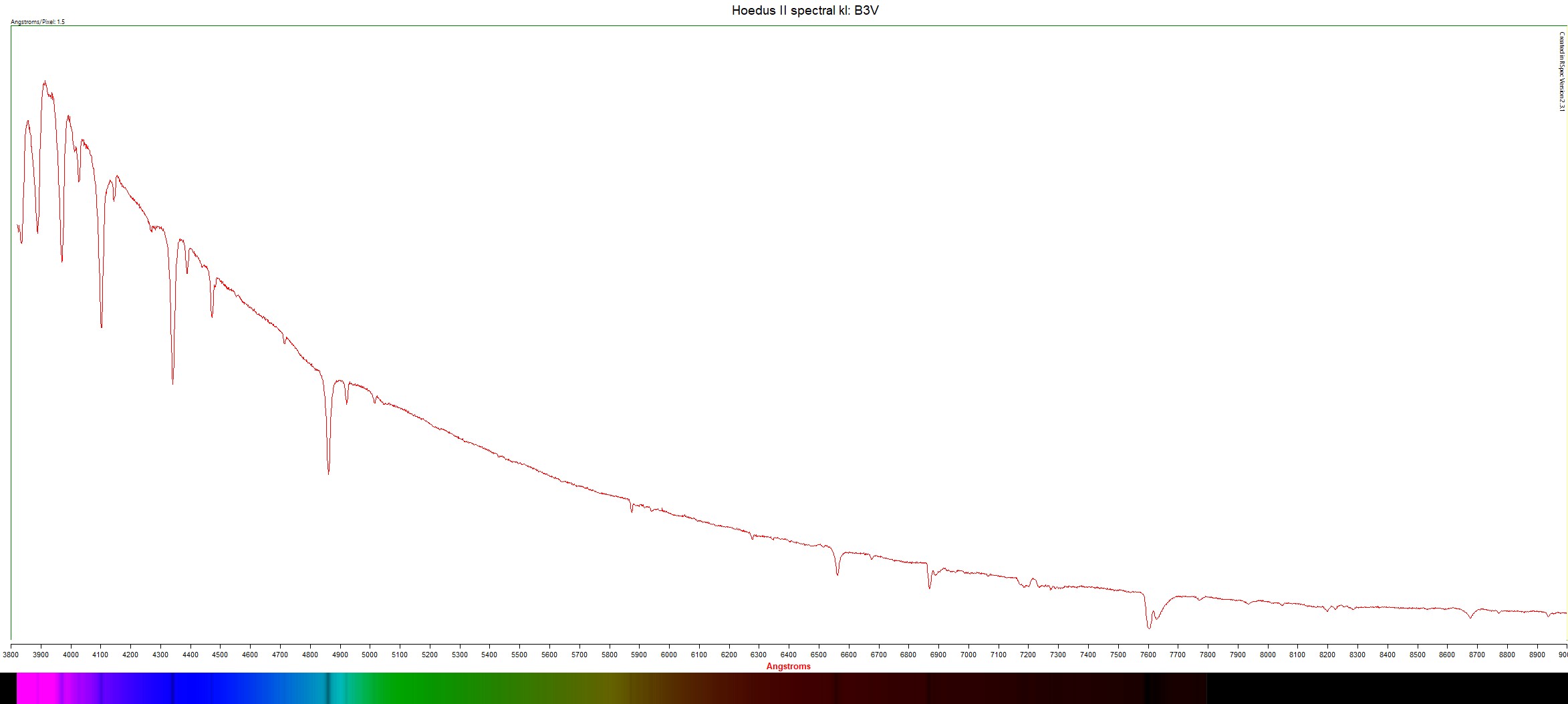
Click image to open in new tab for zooming
Metadata
| Field | Value |
|---|---|
| Object Name | Haedus II |
| Observer | GDAA |
| Site | Sandvreten Observatory |
| Equipment | T41 - Config 1 (200L/mm) |
| Observation Date | 2026-03-17 19:33 |
| Julian Date | 2461117.31458 |
| Exposure Time | 300.0 seconds |
| Created | 2026-05-01 18:52 |
| Updated | 2026-05-01 18:53 |
Notes
Eta Aurigae.Since 1943, the spectrum of Eta Aurigae has served as one of the stable anchor points by which other stars are classified.[4] Eta Aurigae is larger than the Sun, with more than five times the Sun's mass and over three times its radius.[7] The spectrum of this star matches a stellar classification of B3 V,[4] which is a B-type main-sequence star that is generating its energy through the nuclear fusion of hydrogen at its core. It is a chemically peculiar star and a slowly pulsating B-type star with a primary period of 1.29 days.[6] This star is radiating 1,450 times the Sun's luminosity from its photosphere at an effective temperature of 18,660 K.[7] Based upon its projected rotational velocity of 95 km/s,[9] it is spinning with a rotation period of only 1.8 days.[17] Eta Aurigae is around 39 million years old. (Wikipedia)