P Cygni
Observer: GDAA
Spectrum Data
FITS Header Metadata
Show FITS Header
| Key | Value |
|---|---|
| SIMPLE | True |
| BITPIX | -32 |
| NAXIS | 1 |
| NAXIS1 | 6230 |
| CRPIX1 | 1 |
| CDELT1 | 0.394544184083521 |
| CRVAL1 | 4289.93994140625 |
| CTYPE1 | Wavelength |
| CUNIT1 | Angstrom |
| SWCREATE | RSpec 2.3.1.76 |
| VERSION | RSpec 2.3.1.76 |
| OBSERVER | DGRA |
| BSS_SITE | Sandvreten Observatory |
| BSS_INST | T41 |
| OBJNAME | P Cyg |
| DATE-OBS | 2026-09-13T19:07:27 |
| EXPTIME | 60 |
| BSS_VHEL | 0 |
FITS Spectral Image
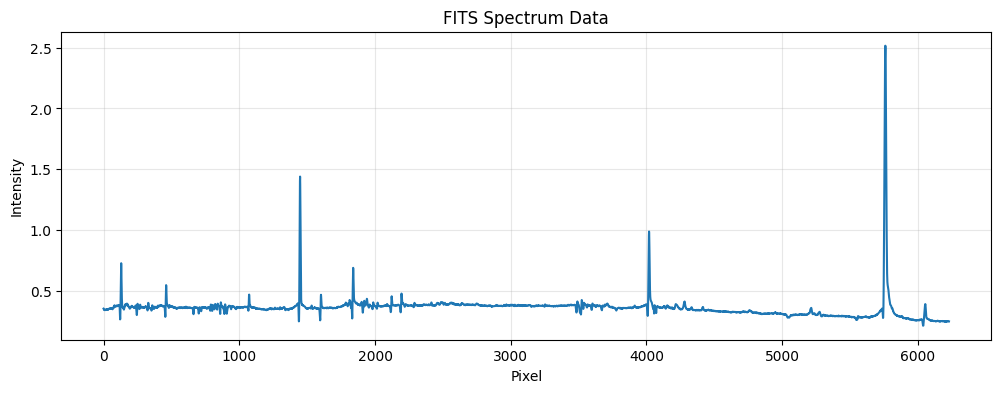
Click image to open in new tab for zooming
Calibrated Spectrum
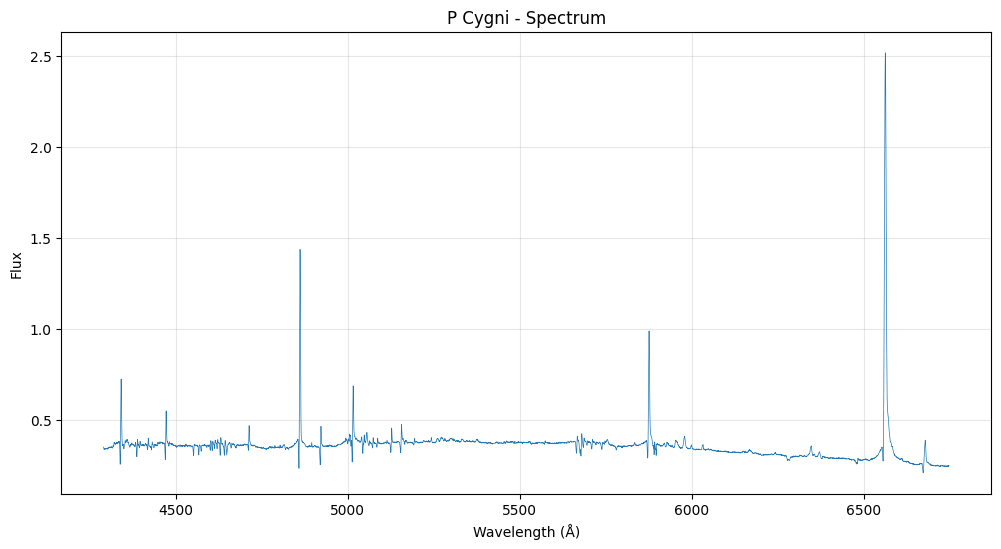
Click image to open in new tab for zooming
Observation Image
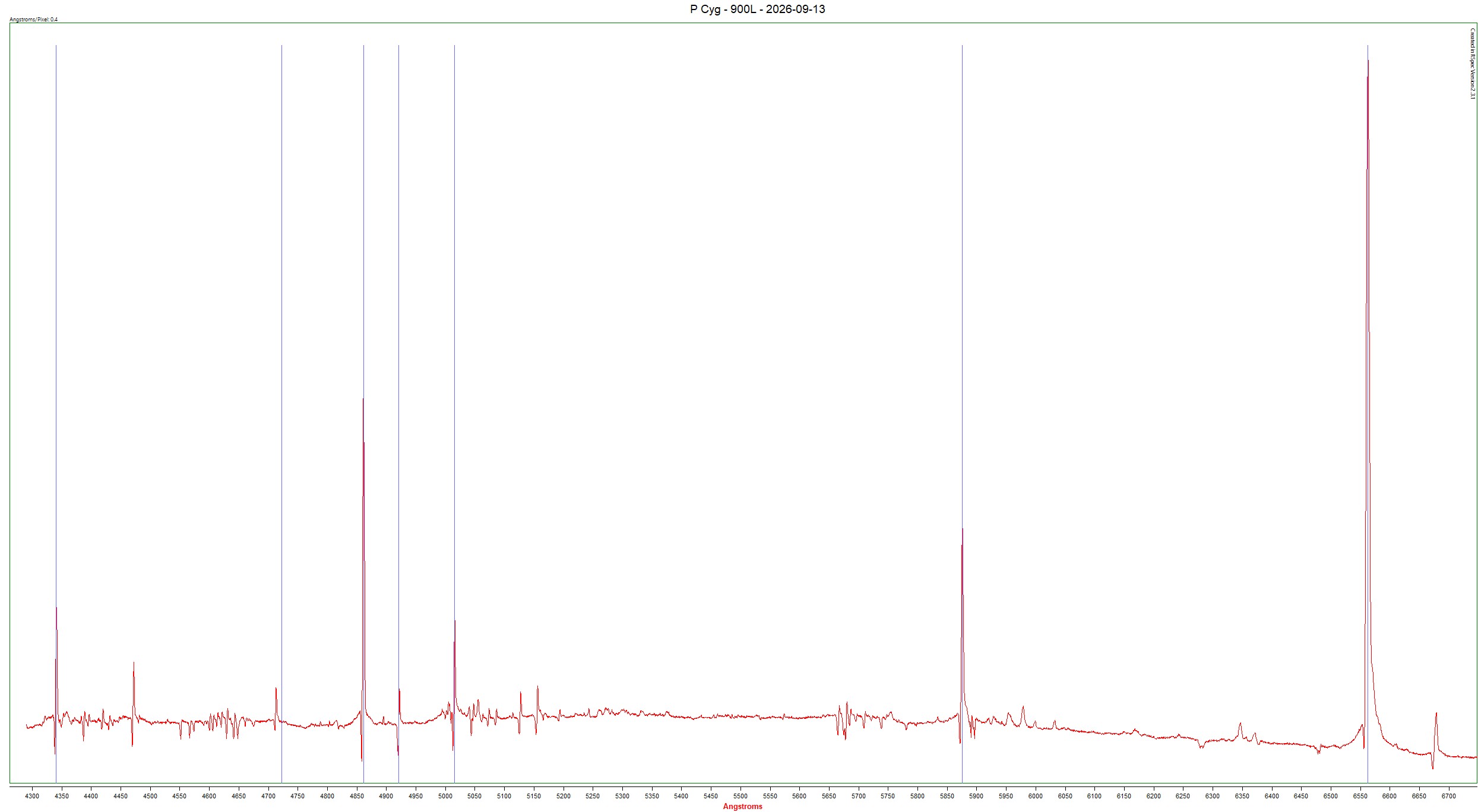
Click image to open in new tab for zooming
Metadata
| Field | Value |
|---|---|
| Object Name | P Cygni |
| Observer | GDAA |
| Site | Sandvreten Observatory |
| Equipment | T41 - Config 2 (900L/mm) |
| Observation Date | 2026-09-13 20:15 |
| Julian Date | 2461297.34375 |
| Created | 2026-09-19 11:19 |
| Updated | 2026-09-19 11:21 |
Notes
The star is located about 5,000 to 6,000 light-years (1,500–1,800 parsecs) from Earth. Despite this vast distance, it is visible to the naked eye in suitable dark sky locations. It was unknown until the end of the 16th century, when it suddenly brightened to 3rd magnitude. It was first observed on 18 August (Gregorian) 1600 by Willem Janszoon Blaeu, a Dutch astronomer, mathematician and globe-maker. Bayer's atlas of 1603 assigned it the miscellaneous label P and the name has stuck ever since.[13] After six years the star faded slowly, dropping below naked-eye visibility in 1626. It brightened again in 1655, but had faded by 1662. Another outburst took place in 1665; this was followed by numerous fluctuations. Since 1715 P Cygni has been a fifth magnitude star, with only minor fluctuations in brightness. Today it has a magnitude of 4.8, irregularly variable by a few hundredths of a magnitude on a scale of days.[14] The visual brightness is increasing by about 0.15 magnitude per century, attributed to a slow decrease in temperature at constant luminosity.[15] P Cygni has been called a "permanent nova" because of spectral similarities and the obvious outflow of material, and was once treated with novae as an eruptive variable; however, its behaviour is no longer thought to involve the same processes associated with true novae.[16] Christiaan Huygens in the 17th century called it the "Revenante of the Swan", in reference to its brightness variations at the time P Cygni gives its name to a type of spectroscopic feature called a P Cygni profile, where the presence of both absorption and emission in the profile of the same spectral line indicates the existence of a gaseous envelope expanding away from the star. The emission line arises from a dense stellar wind near to the star, while the blueshifted absorption lobe is created where the radiation passes through circumstellar material rapidly expanding in the direction of the observer. These profiles are useful in the study of stellar winds in many types of stars. They are often cited as an indicator of a luminous blue variable star, although they also occur in other types of stars.[20][23] In P Cygni itself, the size of the stellar wind H-alpha emission region is 5.64±0.21 milli-arcseconds.[14] At the distance of 1,600 parsecs this is a physical size of approximately 25 stellar radii. (Wikipedia)