WR 134
Observer: Grzegorz Duszanowicz (grzegorzd)
Spectrum Data
FITS Header Metadata
Show FITS Header
| Key | Value |
|---|---|
| SIMPLE | True |
| BITPIX | -32 |
| NAXIS | 1 |
| NAXIS1 | 2765 |
| CRPIX1 | 1 |
| CDELT1 | 1.44606267595084 |
| CRVAL1 | 3801.89575195313 |
| CTYPE1 | Wavelength |
| CUNIT1 | Angstrom |
| SWCREATE | RSpec 2.1.1.18 |
| VERSION | RSpec 2.1.1.18 |
| OBSERVER | HLAD |
| BSS_SITE | Sandvreten Observatory L11 |
| BSS_INST | T41 |
| OBJNAME | WR 134 |
| DATE-OBS | 2025-12-17T17:38:24 |
| EXPTIME | 1200 |
| BSS_VHEL | 0 |
FITS Spectral Image
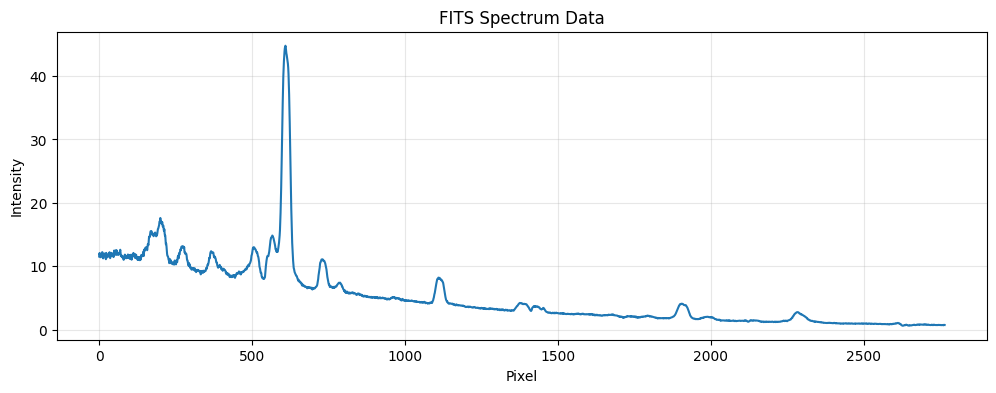
Click image to open in new tab for zooming
Calibrated Spectrum
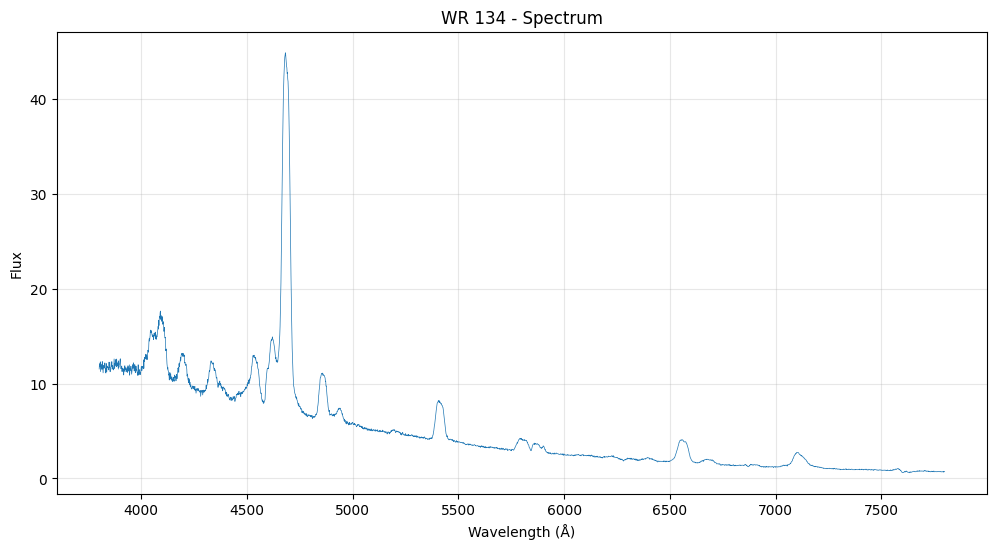
Click image to open in new tab for zooming
Observation Image
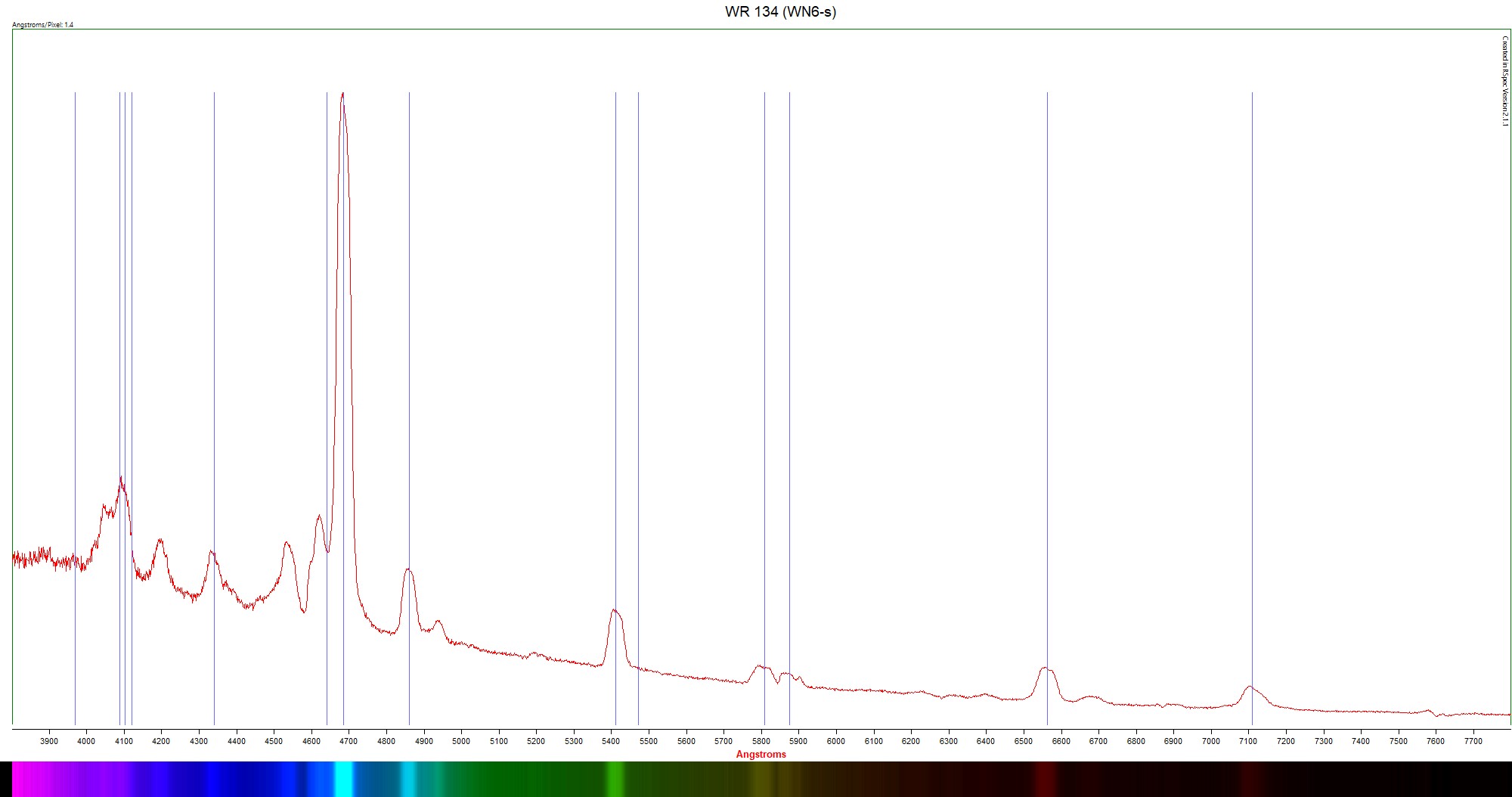
Click image to open in new tab for zooming
Metadata
| Field | Value |
|---|---|
| Star Name | WR 134 |
| Public | Yes |
| Created | 2025-12-23 23:29 |
| Updated | 2025-12-24 12:07 |
Notes
WR 134 was one of three stars in Cygnus observed in 1867 to have unusual spectra consisting of intense emission lines rather than the more normal continuum and absorption lines. These were the first members of the class of stars that came to be called Wolf-Rayet stars (WR stars) after Charles Wolf and Georges Rayet who discovered their unusual appearance.[8] It is a member of the nitrogen sequence of WR stars, while the other two (WR 135 and WR 137) are both members of the carbon sequence that also have OB companions. WR 134 has a spectrum with NIII and NIV emission between two and five times stronger than NV, leading to the assignment of a WN6 spectral type. The spectrum also shows strong HeII emission and weaker lines of HeI and CIV.[9] (Wiki)